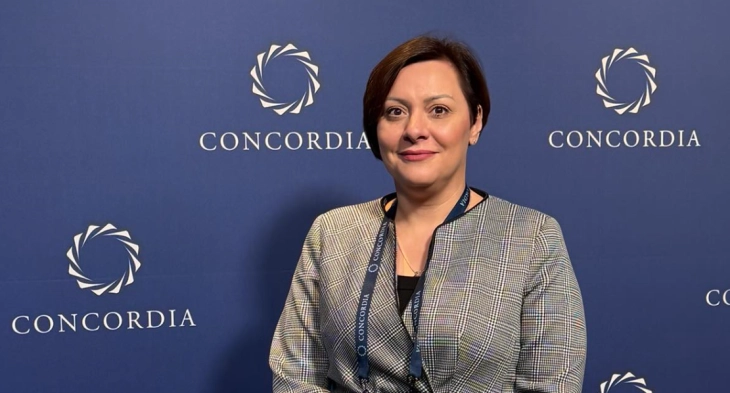
New York, 25th September 2026 (MIA) – During her visit to New York, Minister of Finance, Gordana Dimitrieska-Kochoska, participated in a working session titled “Powering Growth in the New Economy”, organized by the World Economic Forum, where she met with fellow finance ministers, experts and private sector representatives, as well as with counterparts from across the globe. In an interview with MIA, the Minister discussed the need to sustain economic growth amid global crises and the vision for a new, technologically advanced economy that we need to build.
Minister, you are in New York these days attending a number of events, including the World Economic Forum conference. What are the key themes currently shaping the global financial agenda?
- Yes, I am in New York these days at the invitation of the World Economic Forum, while also participating in a number of the events. Among the meetings, sessions and discussions I have participated in so far, I found the discussion titled “Powering Growth in the New Economy” particularly compelling. The very term "new economy" is intriguing in itself. After all, there are no entirely new economies; we are talking about the economies we already know. This naturally raises the question of why the session was given such a title. We associate the term “new economies” with the fact that, over the past four years, we have experienced three successive energy crises. As many participants noted, while this may not become a constant feature of our lives, it is evident that such crises will recur from time to time. At least, these are the forecasts shared by the analysts and experts taking part in these discussions. One of the particularly interesting points raised during the session was that a key priority for economies around the world is the need to focus on long-term growth, with productivity at its core. This is not a new concept for us. However, the focus now seems to be shifting increasingly towards productivity, as it is evident that productivity levels around the world are not yet where they need to be. And given the demographic challenges we are now facing, particularly across Europe, productivity is likely to be even more firmly in focus in the period ahead. With a shrinking workforce, we need to rely more heavily on automation, advanced machinery and so forth. At the same time, this increased reliance on automation and machinery requires a more stable energy environment. Much of the discussion today centers on the importance of electricity for production and the manufacturing sector. One interesting point that was shared was that, according to a 2025 analysis, 73 out of 108 countries had seen a significant increase in energy costs. Naturally, this leads to higher prices, which means that one of our priorities as a country should be to ensure greater stability in this area.
What are we doing as a country in this regard?
- I believe that Macedonia and the Government are making significant efforts in this area. The Prime Minister is particularly focused on the energy sector. I believe it is particularly significant that work on the gas interconnector is progressing at an accelerated pace. Today’s discussions highlighted the example of the United States, which benefits from low electricity prices and a highly reliable supply of gas. And the very fact that gas is being highlighted makes it abundantly clear how important it is for the country and for production as one of its key inputs. As a Government, we are firmly committed to building the gas interconnector. Project is progressing at a very rapid pace, and I believe this will, in turn, help reduce production costs. Furthermore, it is extremely important for the country to keep pace with global development trends. For example, if the global focus is on tackling climate change, Macedonia is expected to contribute as well. At the same time, however, every country must maintain a degree of independence in shaping its own development strategy. There needs to be a balance between global developments and the country’s own priorities.
You mentioned the development of the new economy. What will that entail?
- Particular emphasis was placed on the need to diversify the economy, and I believe this is also one of the areas we, as a country, need to focus on. We still have companies in Macedonia that are primarily engaged in manufacturing components for the automotive industry. We need to gradually change that, not by reducing the number of factories or implying that they are no longer important. They will continue to play a vital role in our economy. Rather, we need to gradually open up opportunities for other types of economic activities that will help diversify risk, while also generating greater value added to the economy. I should also highlight another issue that came up in the discussion, namely the kind of workforce that will be needed in the future. What I find particularly encouraging is that this reflects what we, as a Government, have been saying for the past two years, and what the Prime Minister has repeatedly emphasised: our country needs a highly skilled and productive workforce. While in the past we relied more heavily on labor intensive activities and positioned ourselves as a destination for companies seeking lower labor costs, we now need to gradually transition towards a different approach. This is the direction countries seeking growth are expected to take. Nevertheless, GDP growth of 4.3% was recorded in the second quarter. Growth has remained at just over 3 percent for ten consecutive quarters. The average growth rate over those ten quarters exceeded 3 percent, which clearly indicates that we need to stay focused on long-term growth. That is why these parameters are extremely important to us.
The new high-productivity economy should be built around information technology, supported by the development of data centers and energy infrastructure. Is this where you see our future?
- Yes, definitely. That is how the working session began, focusing on the idea that data centers are the future. European Commissioner Jozef Síkela, who attended the session, noted that for the United States, for example, the future lies in data centers. And when we talk about electricity demand, the electricity needs of the United States, for example, are on an entirely different scale from those of Africa.
This is precisely why the approach varies across continents and, indeed, from one country to another. However, there is no doubt that data centers are the future, and I believe that we should steer the entire economy towards setting up such centers. Certainly, electricity generation capacities are also needed. However, I believe that the Prime Minister, given that this is essentially his area of expertise, knows exactly what Macedonia needs in terms of electricity generation. Investments in the energy sector will help bridge the capacity gap we currently face as regards data centers. As Minister of Finance, I consider this particularly important, as these investments will contribute to GDP growth in the years ahead.
You mentioned the high growth rate Macedonia has achieved compared with the European Union, where growth has slowed down. What do you see as the main challenges to maintaining this pace of growth?
- I have often pointed out that, in certain circumstances, global crises can also serve as catalysts for positive change. Some of these insights can be used to the benefit of both our economy and the companies that are part of global or multinational corporations. There is already interest in expanding production capacities in Macedonia, and therefore, I would not view this crisis solely from a negative perspective. Indeed, GDP growth of 4.3% is a significant achievement, particularly given the developments affecting our major trading partners. And this is something we should leverage going forward. While the German economy is growing slowly, it remains a major economic powerhouse. For a small economy like ours, the potential offered by the German economy is immense. And if we can seize the opportunity, for example, when a factory closes in another country and relocates here, or expands its operations here, I believe we should make the most of it. Even though Germany’s economic growth is currently around 1%, while ours is considerably higher, the sheer size of the German market means that even a modest increase in demand for our products would offer considerable scope for growth and expansion.
The country’s stable credit rating was recently reaffirmed. How would you assess the stability of public finances? The opposition has questioned the sustainability of the Budget.
- Over the past two years, the same rhetoric has been repeated over and over again: “the Budget is on the verge of collapse, we are heading for bankruptcy,” and so on, with claims that pensions would not be paid. Yet, as you can see for yourselves, all liabilities have been repaid on time throughout this period. There are persistent efforts to distort the facts and present them in a way that serves a particular agenda. It is well understood how Budget execution is assessed, and that one should wait until the end of the month before drawing conclusions about the size of the budget deficit. Naturally, you cannot spend more than has been provided for in the Budget. At the same time, the Budget includes a projected deficit, meaning that borrowing cannot exceed the amounts projected under the Budget or the Supplementary Budget. State Budget is stable. Fitch’s reaffirmation of the country’s stable credit rating clearly demonstrates that the situation remains stable, while the growth rate also speaks for itself. I must emphasize that, when it comes to growth, it is not driven solely by Government investments through higher capital expenditure execution. On the contrary, it must also be supported by the private sector. Without the support of the private sector, a growth rate of 4.3 percent would not have been possible through Government investments alone. The Government will certainly continue to place a strong emphasis on capital investments, which has been one of our key priorities from the very beginning. Our decision to support the private sector through favourable loans, or, as some prefer to call it, the Hungarian loan, has also contributed to this. Although we have taken out numerous loans, none of them has ever been labelled a World Bank loan or an IMF loan. Yet it continues to be referred to as the “Hungarian loan.” And that loan has delivered tangible results, as today’s high growth rate is, in part, a result of that financing. Therefore, I can conclude that public finances remain stable. Once again, the credit rating speaks for itself, as does our management of public debt over the past two years. Indeed, the debt situation we inherited was alarming. Public debt exceeded 60% of GDP. As per the latest data, public debt stands at 58.8% of GDP. Our projections reflect our expectations, but most importantly, the proper allocation of budget resources, or public funds, towards capital investment is delivering results in the form of GDP growth. In turn, GDP growth helps us manage the level of public debt.
As a Government, you were forced to take measures to respond to the energy crisis, including reducing fuel duties. How did this affect the Budget?
- Yes, it had an impact on the Budget. According to the initial projections, the reduction in fuel duties was estimated at Denar 1.6 billion in the first half of the year. We expected the situation to stabilize, given the circumstances in June. Unfortunately, oil and petroleum product prices are once again on the rise. As a result, we were compelled to reintroduce measures relating to excise duties and, more recently, to VAT on diesel fuel. This means that we are taking actions to protect citizens’ living standards. which, in turn, has an impact on the Budget. Budget execution to date shows that the collection of revenue from excise duties will be lower than projected. Last week, we held meetings with the Director of the Public Revenue Office and the Director of the Customs Administration. They expected that we would certainly not be able to meet the projected excise revenues.
Does this mean another Supplementary Budget will be necessary?
- Ministry of Finance is currently undertaking an additional review of the figures and further analysis to determine whether there is a need for another Supplementary Budget, which would not be uncommon. In 2022, two Supplementary Budgets were adopted. No Law can anticipate or prescribe how many Supplementary Budgets may be needed over the course of a year. We will adopt as many Supplementary Budgets as circumstances require. No one could have anticipated a war, nor the record-high prices of oil and petroleum products that followed. There is a fundamental difference between the circumstances we faced in the past and those we face today. Above all, I am a Minister who prefers to manage matters as quietly as possible. There is no need for noise or complaints. Whether this is the most severe crisis, the world will be the judge of that. Experts around the world have pointed to its far-reaching impact on all economies. We simply focus on managing the situation and getting the job done. Nothing will change for citizens if I come forward and comment on whether the situation is good or bad. Citizens should know and feel reassured that the situation is under control. Wages are paid on a regular basis, as are pensions. Liabilities are being repaid on a regular basis, and the pace of capital investment execution speaks for itself. Loan liabilities, which are also of critical importance, are being repaid on a regular basis, as any failure to service these liabilities could lead to other complications. This is an important point to emphasize: there have been absolutely no delays. On the contrary, all liabilities have been serviced on time. We must not forget that historically speaking, no Minister has faced the obligation of repaying Eurobonds in each of the four years of their term of office, with EUR 700 million EUR 500 million, EUR 700, million and EUR 500 million falling due respectively. This had never happened before, yet it was during my four-year term that we had to repay a Eurobond in each of four consecutive years.
Government debt in more heavily indebted countries is being viewed as the next major global crisis. Where does North Macedonia stand in this regard?
- We are confronted with such a problem. As for the most recent Eurobond issuance, which took place in January 2026, investor demand was nearly five times the offered amount. Therefore, as a country, we face no challenges when it comes to issuing Eurobonds. The only consideration is the coupon of issuance. We must take a realistic view of the situation. For example, another topic discussed today was the need for scaled-up investments in energy capacities, with some calling for an energy transition and expansion of renewable energy capacity. However, the cost of capital remains very high. If we look back, for example, to 2020, during the COVID-19 crisis, there was excessive supply of money in the financial system, which kept interest rates at historic low levels. For nearly a decade, EURIBOR remained in negative territory, whereas the circumstances we face today are very different. Therefore, perhaps the greatest challenge at this point is to successfully issue a Eurobond at the lowest possible interest rate or margin, as the margin is, in my view, a particularly important factor. That is exactly what we achieved at the Ministry of Finance in January 2026, with the issuance of a Eurobond at the lowest margin ever recorded.