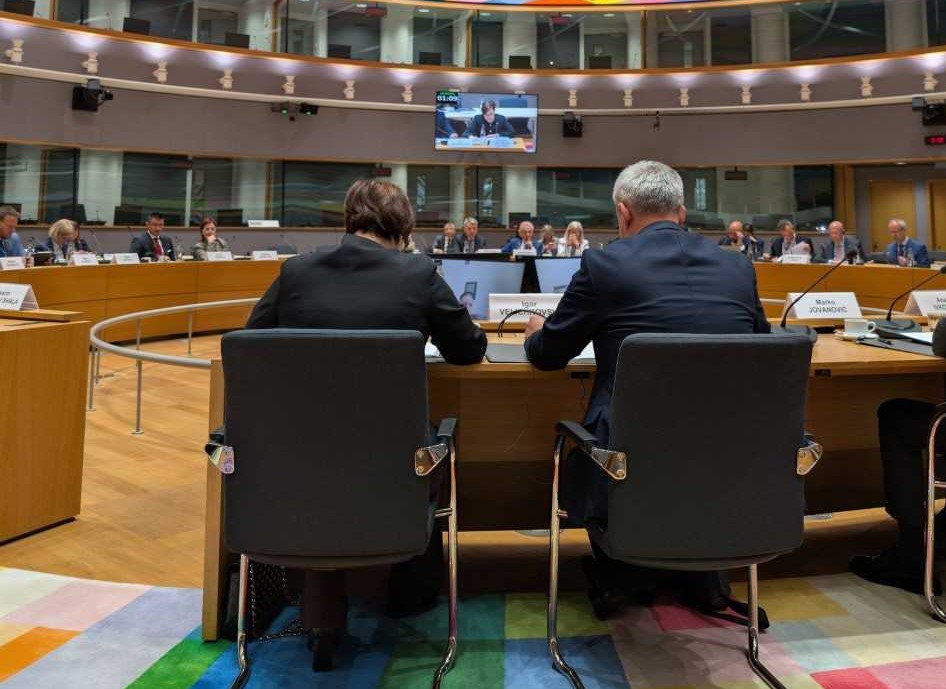
5th May 2026, Skopje - Sustainable public finances and macroeconomic stability are essential amidst heightened global uncertainty, Minister, Gordana Dimitrieska-Kochoska stated in her address at the Economic and Financial Dialogue, taking place in Brussels today.
As part of the 12th Economic and Financial Dialogue, discussions focused on economic development, challenges and future plans, with each country adopting recommendations on targeted policies, which are to be implemented in the coming period.
“Limited fiscal space is the most pressing issue the finance ministers confront after several consecutive crises and the considerable fiscal support provided during the pandemic,” the Minister said.
She stressed that, notwithstanding the challenges posed by global developments and emerging energy pressures, Macedonian economy is anticipated to sustain stable growth, with a moderate slowdown in the short run and a gradual acceleration in the medium term, with vigilant monitoring of risks associated with geopolitical deterioration.
The limited fiscal room, as noted by the Minister, stands as a key challenge, requiring a nuanced approach to balancing investment needs with fiscal stability.
“Fiscal consolidation is proceeding gradually, while economic growth in Macedonia over the coming period is expected to be driven primarily by investments in transport infrastructure, healthcare, education, and agriculture. Moreover, given the rapidly shifting geopolitical climate, the energy sector has assumed priority, as the availability and affordability of electricity have become pivotal for growth, investments, and the broader political agenda. This necessitates substantial efforts to strike an appropriate balance between investment financing needs and constrained fiscal space,” the Minister stated.
Moreover, the Minister highlighted that the focus is placed on implementing reforms aimed at improving public finance management, encompassing gradual fiscal consolidation, enhancing public investment management, digitalization and introduction of e-invoicing, reducing the informal economy and preparing a tax expenditure report alongside spending reviews.
The Minister noted that the EU integration process remains a key driver of reforms, which are geared towards the structural transformation of the economy, the energy and digital transitions, and the improvement of the business environment.
Within the joint conclusions from the meeting, necessity of continued fiscal consolidation through targeted measures, was highlighted, all to the end of reducing the budget deficit and expanding fiscal space.
The Economic and Financial Dialogue takes place annually to address the economic policy. This year’s Economic and Financial Dialogue brings together representatives of the EU Member States, the European Commission and the European Central Bank, as well as Ministers of Finance and Governors of Central Banks of the Western Balkan countries, Türkiye, Moldova and Ukraine.