
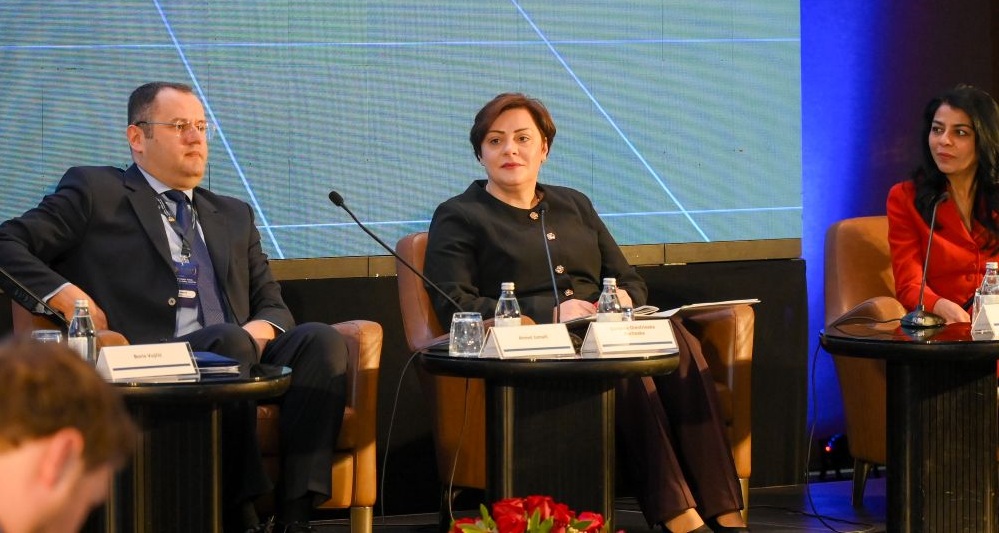
24th March 2026, Skopje – Despite existing liabilities and pressures on the Budget, the Government continuously monitors the developments and implements timely and prudent measures. This message was underscored by Minister of Finance, Gordana Dimitrieska-Kochoska, at today’s conference “Central Banking Amid Persistent Global Shifts: Fostering Stability, Innovation, and Resilience”, hosted by the National Bank.
“The liability servicing profile over the next five years, exceeding EUR 8 billion, presents a substantial burden, posing a significant challenge for the current Government, as year‑by‑year data clearly show that these liabilities are at record‑high levels. To put this into perspective, interest costs in the Budget have grown from around 1% of GDP in 2022 to nearly 2% in 2026, clearly illustrating the scale of the pressure on the Budget and the available fiscal space to respond. The Government must place citizens and businesses at the forefront, especially at a time when countries across the world are taking action, which makes taking certain steps a reasonable course of action,” the Minister highlighted.
She stressed that the country is navigating current developments effectively, and that the key priority for the Government is to prudently target the measures and make prompt decisions.
“As a nation, we are managing current developments very effectively and will consider introducing certain new measures. Yet, I would stress again that our main concern remains the duration of these developments and what their impact will be on the manufacturing capacity,” the Minister said.
She noted that while it is easy to quickly introduce a set of measures, it is essential to carefully assess whether such actions could fuel inflation and whether sufficient space exists in the Budget.
“While it might seem straightforward to approve an 8% budget deficit today, as was done previously, someone will inevitably have to bear the cost of it in the future. I am convinced that a responsible government should adopt targeted and prudent measures and make decisions without delay. This is a moment when even world-renowned experts are emphasizing the need for saving. As the duration of the current developments is uncertain, the households and the companies alike need to prioritize saving. So prudent government action is needed, as the Prime Minister also stated — targeted action — and it is no coincidence that we began with VAT measures, since this was where the circumstances allowed for the most effective intervention. In the future, we will respond as needs arise,” Dimitrieska-Kochoska emphasized, adding that the budget revenue performance is as per the projections and, compared to the previous year, revenues are increasing.
The Minister pointed out that during the current developments, everyone must make a considered effort, including the companies, which have recently received support through various mechanisms, and it is their turn to act now.
“I believe companies are up to the task at this point in time. We are not observing any significant reactions, nor any noticeable impact on prices. This clearly demonstrates our joint efforts to navigate this situation without further fuelling inflation. Going forward, we will continue to monitor the developments on national level, while being mindful of our budget constraints, looming liabilities, and the need for fiscal consolidation. Maintaining stable public finances is our top priority,” the Minister of Finance underscored.
Communication and coordination with the National Bank, as she noted, are of vital importance, having intensified considering the current crisis during which such communication and coordination are essential not only for managing inflation but also for developing effective measures.
Minister Dimitrieska-Kochoska took part in the first panel on the topic of “Anchoring stability in times of high uncertainty: lessons for macroeconomic policies”, alongside Governor Trajko Slaveski, Governor of the Croatian National Bank, Boris Vujčić, Governor of the Central Bank of the Republic of Kosovo, Ahmet Ismaili, IMF Fiscal Affairs Department Deputy Director, Era Dabla-Norris, and Professor of Financial Stability and Director of the Florence School of Banking and Finance, Thorsten Beck