
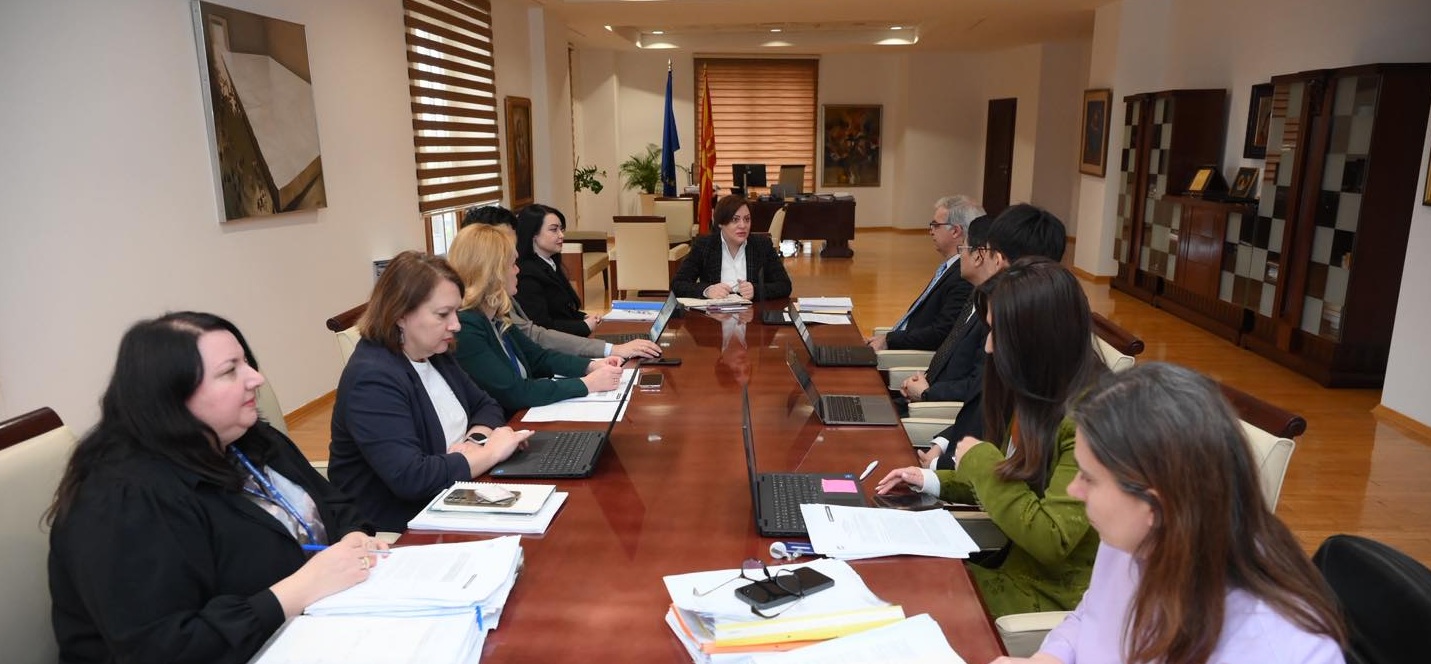
31st March 2026, Skopje - Minister of Finance, Gordana Dimitrieska-Kochoska, together with the team from the Ministry of Finance, held a concluding meeting today with the IMF Mission, led by the Head of Mission, Nikoloz Gigineishvili, as part of the regular 2025 Article IV consultations.
During the meeting, the mission’s key findings were summarized, and recent macroeconomic trends, fiscal policies, and the outlook for the period ahead were discussed, along with risks stemming from the external economic environment.
It was concluded that Macedonian economy continues to record stable growth, accompanied by positive developments in economic activity, a gradual easing of inflation, and favorable labor market trends.
Growth continues to be driven by domestic demand, exports, and investments, with emphasis placed on sustaining investment activity, particularly in infrastructure and public investment projects.
At the same time, the Government’s commitment was highlighted to pursue gradual fiscal consolidation, strengthen public financial management, improve revenue collection, and enhance the efficiency of public spending.
In this respect, IMF staff underscored that the budget deficit is projected to continue its decline in line with the medium-term fiscal strategy, aimed at ensuring long-term sustainability of public debt amidst global uncertainty.
IMF representatives commended the country’s fiscal discipline and consistency in implementing the economic policies, noting that they are on the right track, with the 2025 budget deficit successfully maintained at the projected 4% target, and encouraged further pursuit of fiscal consolidation.
The need was emphasized to keep the budget deficit and public debt in line with the set fiscal rules and framework, despite heightened uncertainties in the global economy.
In the context of heightened global risks, including geopolitical tensions and energy price pressures, the IMF highlighted the importance of implementing targeted, time-bound, and fiscally sustainable measures to support households and businesses. IMF representatives also underscored that the measures should be precisely targeted, aiming to preserve macroeconomic stability, strengthen revenue collection, and reduce the informal economy.
A conclusion drawn at the meeting is that continuity in implementing prudent and responsible economic policies, together with further structural reforms, is critical for strengthening economic resilience, maintaining confidence, and ensuring stable and inclusive economic growth.