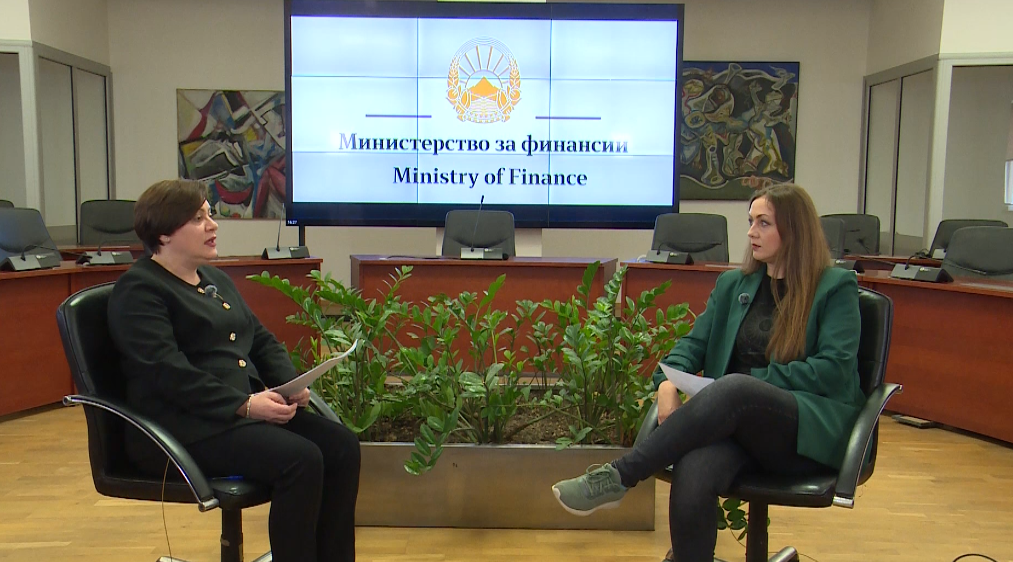
19th May 2026, Skopje – The latest external borrowing is secured under significantly more favorable terms and conditions, including lower interest rates and longer maturity, reflecting strengthened confidence of international financial institutions in the Macedonian economy, Minister of Finance, Gordana Dimitrieska‑Kochoska, said in an interview with Alfa TV.
With regard to the borrowing from foreign banks, for which a law is currently undergoing parliamentary procedure, the Minister highlighted that the Ministry of Finance sent requests for proposals to 14 banks, eight of which submitted offers, with loan interest rates achieved under more favorable terms and conditions compared to regional benchmarks, indicating that the Ministry of Finance has obtained highly competitive financing.
“The 2026 Budget clearly states an external borrowing plan of EUR 1.3 billion, with EUR 1 billion raised through a Eurobond at the beginning of the year and the remaining EUR 300 million also being secured on the external market. In the course of the borrowing process, we received offers from eight different banks, and the most advantageous one features an interest rate lower than that of the bond currently trading on the secondary market,” Dimitrieska-Kochoska stated, highlighting that compared to other countries in the region, Macedonia has secured lower borrowing costs and longer repayment period, thereby placing the country in a more favorable financial position.
“Montenegro borrowed a five-year loan with applicable EURIBOR rate plus 2.5% margin, whereas we secured a seven-year loan with EURIBOR rate plus 2.1% margin. While we were issuing the Eurobond, Romania was facing higher interest rate than ours, exceeding somewhat 5%,” the Minister said, adding that this is evidence of improved public finance management and growing confidence among international creditors.
“It should be noted that the banks involved in the financing are European, including reputable banks from the United Kingdom, which clearly reflects the high level of confidence in Macedonia among international financial institutions and creditors,” the Minister said.
With regard to the fiscal framework, the Minister noted that sufficient funds are projected in the 2026 Budget for regular servicing of public debt, thus ensuring stability, predictability and timely fulfillment of obligations. She added that the state of public finances should be assessed through real figures, comparative analysis and in terms of meeting financial obligations.
“With public debt still below 60% of GDP, Macedonia holds a better position than a number of countries in the region as well as certain EU member states. Romania’s public debt stands at around 63% of GDP, Hungary’s at about 75%, Poland’s at roughly 70%, and Slovenia’s at around 65%,” the Minister said, emphasizing that such data confirm the country’s continued moderate level of indebtedness and a prudent approach to public finance management.
Regarding the borrowing structure, the Minister noted that a large portion of the new funds is used to repay existing liabilities and arrears, a common practice for countries aiming to preserve financial stability and maintain repayment continuity.
“What is important is that the Government continues to pursue a policy of not using borrowed funds for non-productive spending, but rather for capital investments, infrastructure and projects that generate economic growth and support long-term development,” the Minister said.
As Dimitrieska-Kochoska stated, in parallel to these processes, the Ministry of Finance is also actively working on preparing the Supplementary Budget.
“As part of preparing the Supplementary Budget, we are engaged in intensive discussions with all ministries, analysing and identifying potential savings, compliance with spending limits, as well as needs for additional funding for implementation of projects and policies. Our obligation is to safeguard fiscal stability and ensure prudent management of public funds,” the Minister said.