
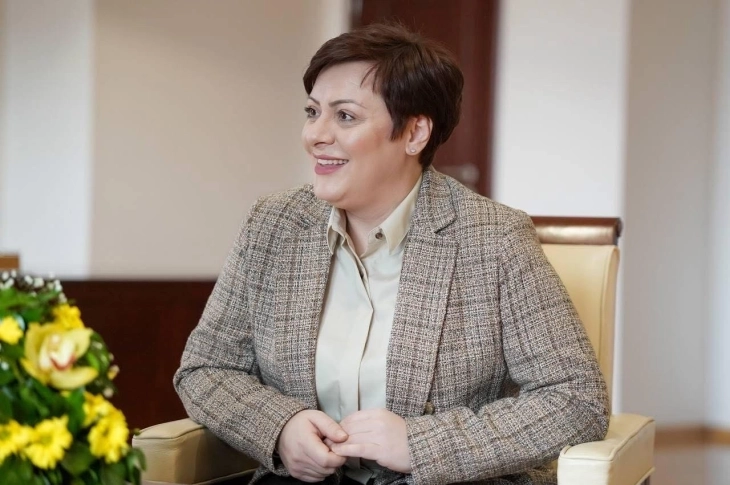
13th May 2026, Skopje – The protection of citizens’ living standards remains our focus, and the Supplementary Budget will remain within this scope, Minister of Finance, Gordana Dimitrieska-Kochoska said in an interview for MIA referring to the discussions on the Supplementary Budget currently taking place.
According to Dimitrieska-Kochoska, citizens can be assured that the Budget is liquid, with all liabilities being serviced. Wages and pensions are paid on regular basis, while liabilities to the business sector are also serviced.
- In this respect, Dimitrieska-Kochoska highlighted that budget items contributing to economic growth and being executed in line with the projections, particularly capital investments, as well as measures to support citizens, aimed at improving living standards, will remain unaffected.
In her view, the Supplementary Budget will remain aligned with the medium-term fiscal framework set out in the 2027–2031 Fiscal Strategy.
According to the published data, in the first quarter of this year, public debt amounted to EUR 10.747 billion in absolute terms, accounting for 59.7% of the GDP, the Minister underscored, being a decrease by 1.5 percentage points compared to the stock as of 30th June 2024, when this Government took office.
- We are pursuing a highly prudent approach in managing public debt and public finance in general, and remain firmly committed to creating conditions conducive to higher and sustainable growth rates, the Minister of Finance said.
The full interview with the Minister of Finance, Dimitrieska-Kochoska, for MIA is provided below:
Minister, you have started discussions on the topic of 2026 Supplementary Budget. Which budget items are expected to undergo changes, and where might cuts be anticipated?
- Since the beginning of this week, meetings have been held with budget users regarding the preparation of the 2026 Supplementary Budget, with the aim of setting priorities for the remainder of the year, taking into account the uncertainties arising from geopolitical developments and the war in the Middle East. It should be borne in mind that our economy is not immune to external developments. Therefore, we are pursuing a highly prudent approach to policy-making process, aimed at ensuring stability, resilience, and sustainable development of Macedonian economy.
The discussions with the ministers are centred on the already completed projects and the realistic expectations as regards the Budget execution by the end of the year, with the aim of allocating funds towards viable priorities delivering tangible results.
The protection of citizens’ living standards remains our focus, and the Supplementary Budget will remain within this scope. Citizens can be assured that the Budget is liquid, with all liabilities being serviced. Wages and pensions are paid on regular basis, while liabilities to the business sector are also serviced. In this context, Dimitrieska-Kochoska highlighted that budget items contributing to economic growth and being executed in line with the projections, particularly capital investments, as well as measures to support citizens, aimed at improving living standards, will remain unaffected.
At present, discussions are underway, and upon their conclusion, a clearer picture will be provided. By and large, the Supplementary Budget will remain within the medium-term fiscal framework set out in the 2027–2031 Fiscal Strategy, recently adopted by the Government.
You pointed out that, under the Supplementary Budget, the Government steadfastly upholds its commitment to the set goal of achieving fiscal consolidation. Whether and when will the fiscal rules be attained, in other words a budget deficit capped at 3% and public debt of up to 60%?
- As for the adopted Fiscal Strategy, serving as the foundation for the fiscal policy, which will be pursued this year and reflected in the Supplementary Budget, the principal objectives cover safeguarding of sustainable and stable public finances over the medium and long run, implementation of gradual and accountable fiscal consolidation through deficit reduction, as well as preservation of macroeconomic and financial stability amidst energy and price volatility. When I refer to fiscal consolidation, I frame it around fiscal accountability and discipline in planning and employing public funds, within the realistic and sustainable fiscal capacity. In practice, this implies a gradual implementation, without abrupt restrictions, so as to avoid both causing harm to the economy or interrupting the cycle of economic growth of nearly 3.5% achieved over the past year and a half. Thus, in line with the point you raised in your question, we are striving to meet the 3% deficit target by 2028 and to reduce it even further thereafter, while at the same time ensuring conditions conducive to economic growth. Fiscal consolidation is not merely a matter to be addressed, but rather a process that is all the more essential in view of the ongoing uncertainties, requiring the putting of buffers in place to withstand potential future shocks. I would underscore that this is a matter of significant importance, one that extends beyond our own circumstances, as many European countries are grappling with high budget deficits. Yet for our country, this represents an even greater challenge, given our status as a developing country. Hence, the central priority of the fiscal policy continues to be fiscal consolidation, accompanied by prudent and disciplined planning and spending of public funds.
Is this approach also reflected in the field of public debt management? What strategic approach is the Ministry of Finance pursuing?
- In accordance with its regular reporting cycle on public debt, the Ministry of Finance published the data on the stock of public debt for the first quarter of 2026 at the end of April. According to the published data, public debt amounts to EUR 10.747 billion in absolute terms, or 59.7% of GDP, decreasing by 1.5 p.p. compared to the stock as of 30th June 2024, when this Government took office.
Put simply, budget funds have contributed to economic growth, which, in absolute terms, exceeds the increase in public debt. And when it comes to borrowing, its justification is ultimately determined by the purposes it serves. For the sake of clarity to the public, when it comes to borrowing, this Government is confronted with a major challenge in servicing debt liabilities inherited from the past, which are falling due over the course of these four years. Let me recall that last year we repaid the EUR 500 million Eurobond. This year, the EUR 700 million Eurobond falls due for repayment, with half already being repaid and the remaining portion scheduled for repayment in the course of June 2026. Put more plainly, this Government is obliged to repay a total of EUR 9 billion as existing debt liabilities on the basis of principal and interest, between 2026 and 2031.
Public debt management, particularly given the perceived boundary of 60%, requires utmost prudence in order to safeguard public finance stability, while simultaneously providing the funding required for economic development. The figures speak for themselves, and they help us better understand how public debt is managed. In 2017, public debt stood at EUR 4.78 billion, rising to EUR 8.87 billion by the second quarter of 2024, marking a twofold increase during the tenure of the previous Government. Let me stress once more that between the second half of 2024 and the first quarter of this year, EUR 1.2 billion was provided solely for repaying the respective Eurobonds. This amount covers only principal and just one portion of the debt liabilities that had fallen due. In addition, further liabilities remain, stemming from project implementation, coupled with domestic debt liabilities. I attach particular importance to the funds we provided for municipal projects during this period, and unquestionably the EUR 250 million provided as support to the economy. Although this amount is currently recorded in public debt figures, it will ultimately be repaid to the Budget. Most importantly, this Project has delivered tangible impact on the economic development. I would also like to highlight that we pursue a highly prudent approach in managing public debt and public finance in general, and remain strongly committed to creating conditions conducive to higher and sustainable growth rates.