
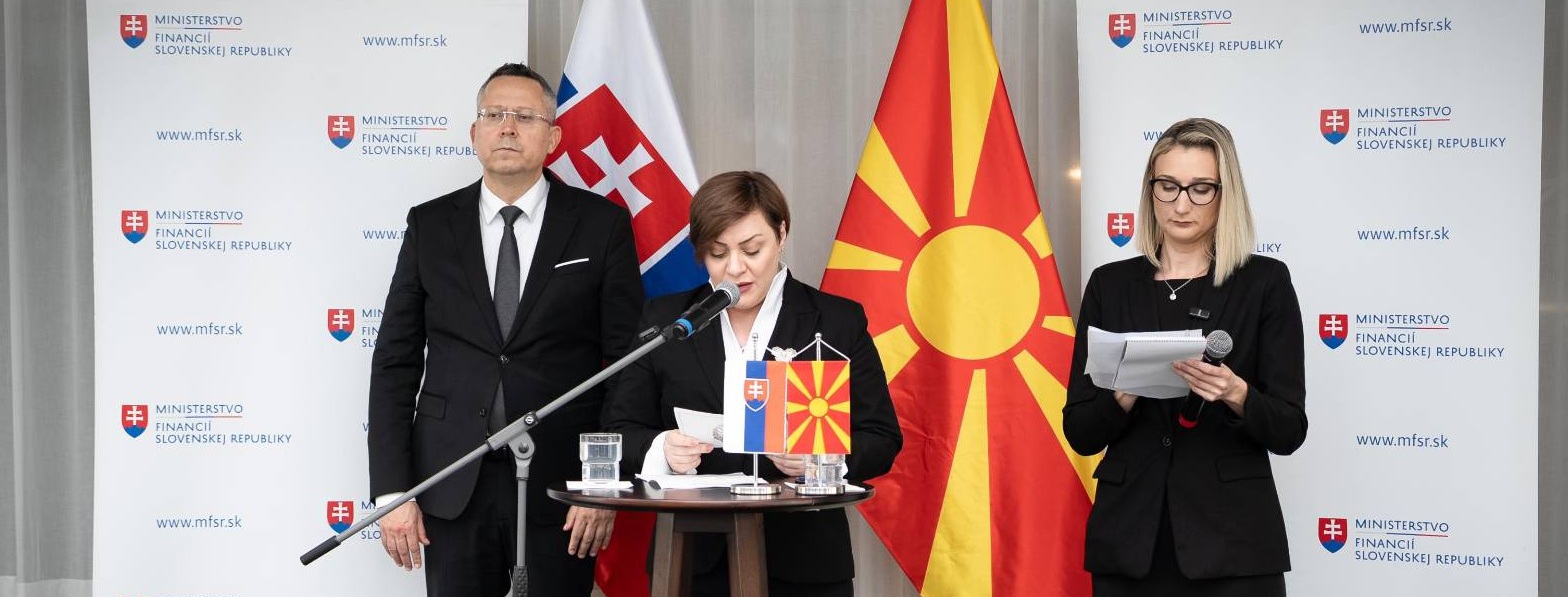
7th May 2026, Bratislava - Digitalization of tax processes, strengthening public finance management, spending review process and further deepening of the economic cooperation were key topics of discussion at the working meeting between the delegations of Macedonia and Slovakia, led by their respective Ministers of Finance, Gordana Dimitrieska-Kochoska and Ladislav Kamenický, held today as part of the Minister’s official visit to Slovakia.
During the working meeting, discussions focused on the current macroeconomic and fiscal developments, spending review and managing and evaluating public investments, as well as digital tools in the tax system, including e-invoicing, e-fiscalization and QR-code payments.
“First and foremost, allow me to express my appreciation for today’s meeting with my colleague, the Minister of Finance of the Slovak Republic, Mr Ladislav Kamenický, as well as my gratitude for the warm hospitality and constructive approach demonstrated during our discussions. This meeting represents yet another confirmation of the high‑quality and ongoing dialogue between our two countries and our shared commitment to further deepening economic cooperation”, Minister Dimitrieska-Kochoska said at the joint press conference.
As she underlined, Slovakia’s experience in the digitalization of tax processes is a notable example of how technology can be leveraged to boost efficiency and transparency, while strengthening efforts to combat the informal economy and tax evasion.
Additionally, Spending Review process was also discussed, to be launched in Macedonia in the course of 2026 under the 2024–2027 Reform Agenda, as an important mechanism for enhancing efficiency and transparency in public finance management.
“Macedonia is already introducing e-invoicing, with its full implementation expected by the end of the year”, the Minister pointed out.
Minister Dimitrieska-Kochoska also touched upon the economic trends in the country, highlighting that the Macedonian economy recorded growth of 3.5% in 2025, driven primarily by investments and domestic demand, and further supported by infrastructure projects and the private sector. On the 2026 economic outlook, she stressed out that the Government remains cautious given the global uncertainties, with the growth projection driven by investments, structural reforms and support from the private sector.
“For us, the focus remains clear – maintaining stable public finances, supporting investments, digitalizing public services, combating informal economy and strengthening the business environment”, the Minister highlighted.
She went on by saying that Slovakia’s experience as an EU Member State is of particular importance for Macedonia, especially in the field of public finance management and implementing reforms related to EU integration.
Minister Kamenický underscored Slovakia’s readiness to share experience and expertise in public finance, digitalization and reform processes, with the goal of driving the economic progress and EU integration of Macedonia.
The Minister expressed confidence that future cooperation will deepen through tangible initiatives, exchange of expertise and joint efforts aimed at fostering economic development and improving the conditions for the citizens and the businesses in both countries.