
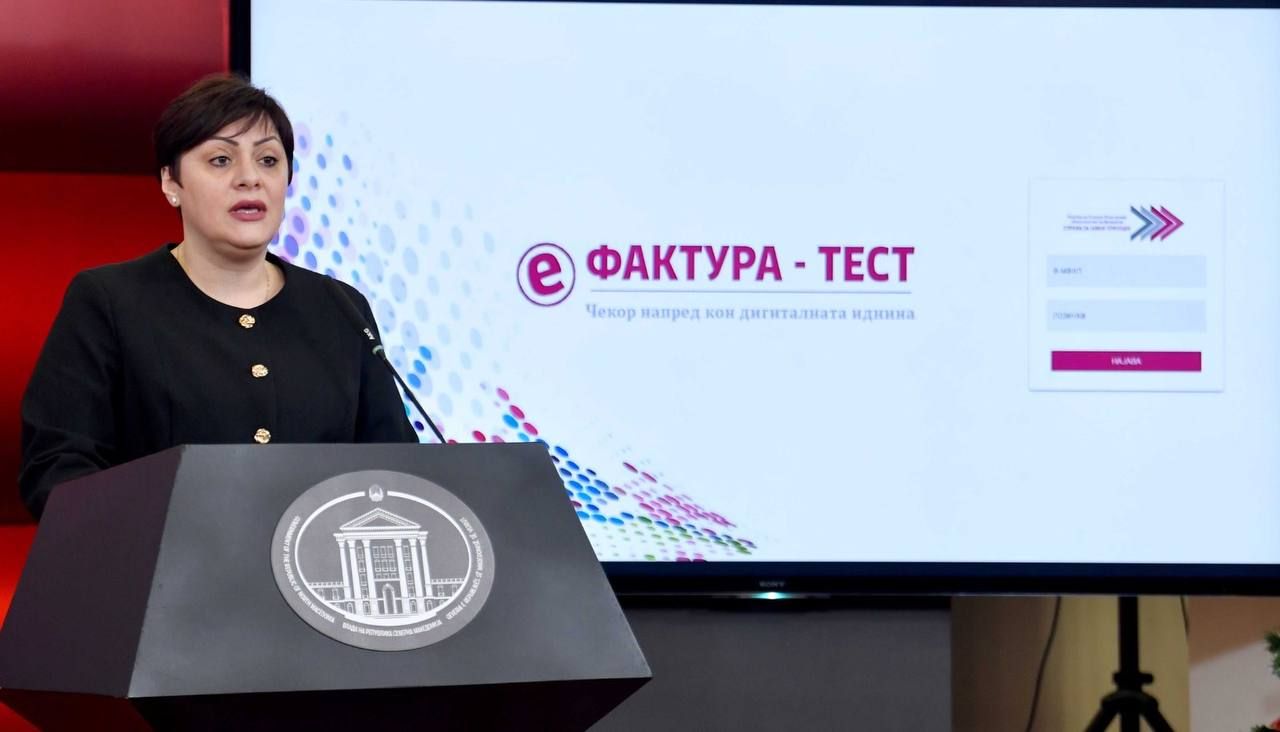
5th January 2026, Skopje - On Monday, Minister of Finance, Gordana Dimitrieska-Kochoska, together with the Director of the Public Revenue Office, Elena Petrova, announced the launch of the E-Invoicing System, describing the move as a major public finance reform and a decisive step in combatting the informal economy.
“The fight against the informal economy, i.e. its formalization, is our Government priority and part of its four-year Program. As per the estimates by the World Bank, the IMF, and the European Commission, the informal economy in our country accounts for approximately 30% of GDP, exceeding the average across EU Member States. Therefore, a systematic approach is required, accompanied with measures that will address the shared interests of both the state and the business community. The informal economy has a strong impact not only on the Budget revenue collection, but also the implementation of projects aimed at improving healthcare, education, and social protection, while also fostering innovations and economic growth,” the Minister of Finance, emphasized at a press conference.
She stressed that the process digitalization within the Public Revenue Office, as well as other institutions, is crucial for increasing efficiency in collecting revenues and spending budget funds.
“E-Invoice is part of our efforts to digitally transform public finances. “I would like to commend the Public Revenue Office for implementing this significant reform, which is beneficial to the state by reducing the informal economy, while also yielding substantial benefits for the economy and the businesses,” Dimitrieska-Kochoska pointed out.
As she elaborated, the new electronic system will replace traditional processes that rely heavily on paper and physical documents, thus reducing administrative burdens and simplifying business operations.
Minister emphasized that the digitalization, along with the easing of numerous administrative burdens allow companies to concentrate their resources on the most critical areas of their development and growth.
“E-Invoice provides for making the economy fairer, more transparent, and more open to investments, while elevating the competition to a higher level. Thus, we ensure fair working conditions and lay the foundation for sustainable economic growth, which directly contributes to improving citizens’ living standard. At the same time, the E-Invoice will allow the state to collect taxes more efficiently, based on accurate and reliable data, while reinforcing targeted efforts in combatting the informal economy,” Minister of Finance stated.
She stressed that the introduction of the E-Invoice is part of the Government’s systemic approach to tackling the informal economy, which contributes to increasing the transparency and strengthening the trust between tax authorities and the business community. According to her, this strategy fosters a partnership for healthier and more competitive economy, coupled by higher growth rates, scaled-up investments, job creation, and higher wages.
By pointing out that the E-Invoice is not merely a technical solution but rather a cornerstone of a modern and accountable economy, which will provide the state with timely and accurate data in support of pursuing sound and sustainable economic policies benefiting both the citizens and the business sector.
At the press conference, she also announced that the Ministry of Finance has initiated activities to introduce a new mechanism for independent and objective verification of the application of tax regulations in specific tax procedures. This mechanism will ensure fair and equitable treatment, provide security for taxpayers, prevent subjectivity in the tax inspectors’ decision-making process, and reduce disputes resolved throughout court proceedings. In addition, the Ministry will, together with the Public Revenue Office, initiate the design of an internal quality control mechanism within the institution itself.