
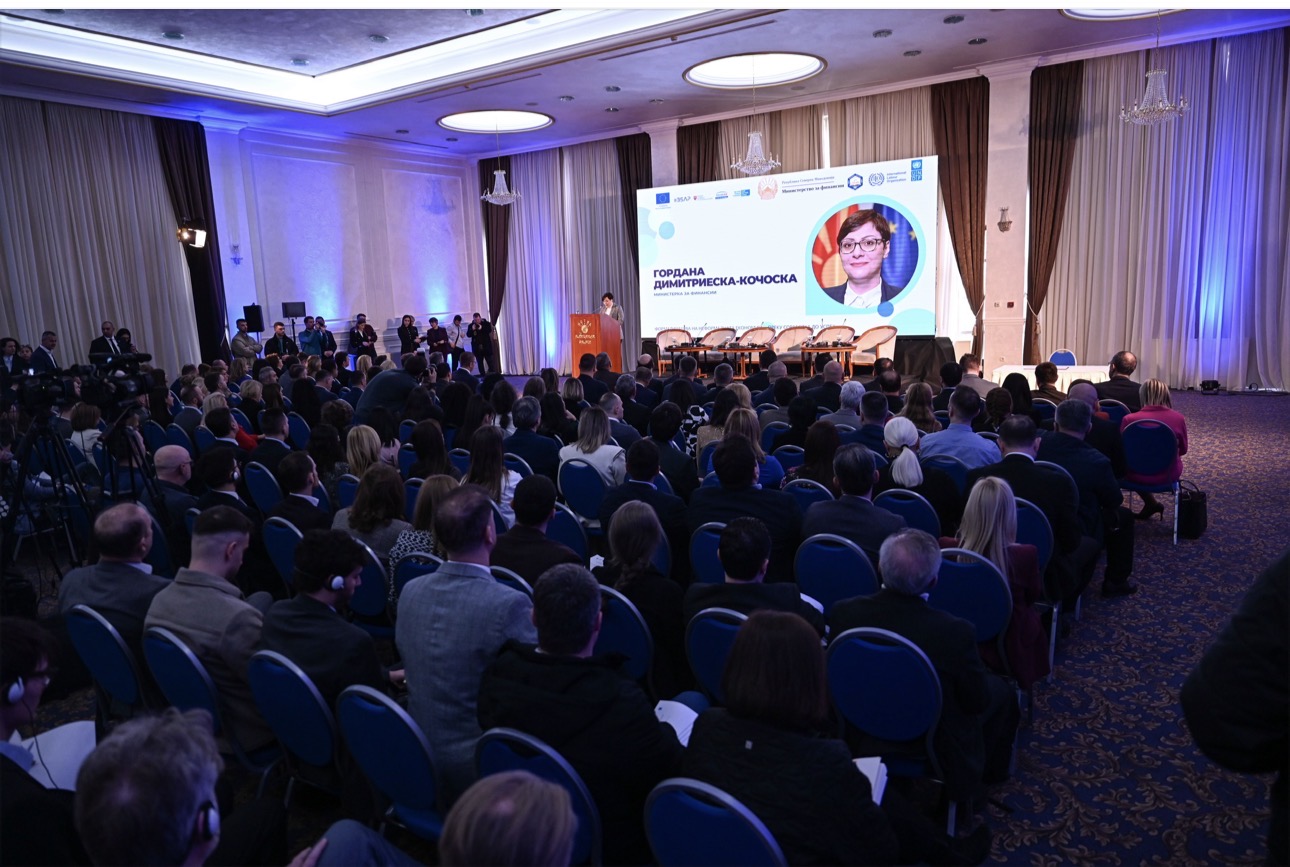
18th February 2026, Skopje Distinguished representatives of institutions, the business community, international partners and civil society organizations, it is my utmost privilege to address you today as key stakeholders in achieving the shared objective that unites us: the formalization of the informal economy, while the success of this effort depends, above all, on the commitment and the steadfast engagement of each institution, as well as on the strong coordination, the inter-institutional cooperation and the partnership.
Informal economy is a complex and multifaceted phenomenon with far-reaching implications for the long-term economic growth and the institutional stability. Although the informal economy exists globally, its size differs across countries. The extent of its prevalence is one of the fundamental factors that distinguishes economies worldwide. It directly affects the decisions of potential investors and shapes how countries perceive one another in terms of stability, transparency and competitiveness of their economies. Whenever the informal economy is discussed, informal employment and tax evasion are often the first issues that come to mind. However, the informal economy is a far broader phenomenon and can manifest across diverse segments of the economic activity. We must always bear in mind that we live in an era of rapid changes, where innovations continuously generate new products, services and business models. If not promptly recognized and adequately regulated, these developments may create a legal vacuum, what economists frequently refer to as the grey zone. Thereby, it is important to acknowledge that a certain degree of institutional sluggishness is not unique to our country, but a global challenge. Such sluggishness can slow the integration of emerging activities into the formal sector. The less flexibility and fewer viable options legislative framework provides, the greater the space for the informal economy. Therefore, modern and adaptable regulations are a key prerequisite for reducing informality and fostering sustainable economic development.
Informal employment and unregistered production directly erode productivity and competitiveness, constrain budget revenues and undermine public finance sustainability. The result is fewer resources for healthcare, education and social protection, on one hand, and unfair competition, injustice towards compliant businesses and eroded trust in the system, on the other.
Let us be clear that our aim is not repression. On the contrary, our goal is formalization, fairness and creating level playing field for all. We will pursue a systemic and resolute approach by tackling unfair competition, fostering fair and transparent business conditions and ensuring that law-abiding companies are not placed at a disadvantage. Formalization will be fostered through streamlined administrative procedures, simplified registration process and clear rules. We will encourage entities operating in the informal sector to transition into the formal economy through support, not solely through sanctions.
Although strategies and plans to combat informal economy have existed, past efforts lacked the necessary resolve in implementation and in delivering concrete results.
Today, the Ministry of Finance is fully committed to combating the informal economy.
We began by grounding our efforts in key policy framework - the 2023 - 2027 Strategy on Formalization of the Informal Economy and related 2023 - 2025 Action Plan, which is currently being revised to define clearer objectives and a more robust, systemic approach to reducing informality.
With the revised 2026 - 2027 Action Plan, we will set a clear and measurable target - to reduce the informal economy from 28.9% to 26% of GDP by the end of 2027. While this may seem a modest reduction at first glance, effective delivery of this target is paramount. In this regard, the active involvement of all relevant institutions in implementing the Strategy and its measures is essential. Today’s signing of the Declaration on Partnership and Action further underscores this commitment. The Declaration reflects our joint dedication to the formalization of the informal economy. It marks an important step towards a systemic and coordinated response, demonstrating the shared dedication of the public institutions, the business community, the trade unions and the academia.
Digitalization constitutes the second key instrument in this effort. For that reason, we have adopted a decision and launched the implementation of the e-invoicing system. This system will ensure comprehensive and centralized recording of all transaction nationwide, as invoices issued outside the system will not be considered valid. However, the system is not an end in itself - it is a foundation upon which we will build further reforms, ultimately moving towards pre-populated VAT returns. This will reduce administrative burden on the businesses, streamline their operations and foster greater productivity.
In the period ahead, the PRO will undergo comprehensive digital transformation. For the first time since independence, it will be possible, simply by entering the taxpayer’s TIN or PIN, to access all relevant information about the taxpayer within a single system. This will replace the current non-centralized framework and significantly enhance the efficiency and effectiveness of the PRO’s operations.
At the same time, we are reinforcing the tax morale and applying a strict zero-tolerance approach to organized tax evasion. Over the past year, you have witnessed all activities undertaken by the PRO to encourage timely reporting of tax liabilities, through continuous communication via social media and regular reminders to the taxpayers regarding their payment obligations.
Third, and of particular importance, the Ministry of Finance is actively pursuing a comprehensive alignment of the legal framework, which involves not only harmonization with the EU acquis, but also refinement of the provisions that have been ambiguous and have long remained overlooked and insufficiently precise. Such shortcomings create legal uncertainty for the taxpayers and may allow certain economic activities to shift beyond formal channels. Moreover, we are addressing the longstanding recommendations from the international financial institutions concerning the systematic identification and analysis of tax exemptions. Some of these exemptions lack sufficient clarity and result in substantial tax expenditures. It is important to draw a clear distinction: tax exemptions in themselves do not constitute informal economic activity. However, when they are not clearly defined and transparent, they can create room for misuse and tax evasion.
Our commitment is therefore unequivocal - clear and precise regulations, legal certainty and equal rules for all.
A central promise of our pre-election platform, and one we remain committed to, is to maintain the existing tax rates, ensuring stability and predictability for the business community. We are aware that high taxes and duties create an additional burden, and when the state sets high tax rates, some citizens and businesses may seek to evade their obligations, directly fueling the informal economy. For that reason, we are implementing fiscal consolidation responsibly, without increasing the tax burden. In doing so, we are restoring trust in the institutions, which is an essential factor in effectively reducing the informal economy.
We are also working on simplifying the administrative procedures, understanding that complex bureaucracy and lengthy processes discourage citizens and companies from operating within the formal economy.
At the same time, we are strengthening the inspection control and the system of sanctions, because when oversight is weak and the risk of detection is low, opportunities for informal economic activity grow. Yet, our goal is not merely to punish, but it is rather to provide security and fair conditions for the private sector. That is why the Ministry of Finance has already initiated activities to reinstate the appeals process against tax and customs administration decisions, providing an independent and objective mechanism to review the application of tax and customs regulations in specific cases. This mechanism will provide businesses with greater certainty, ensure predictability, prevent subjectivity in the decisions of tax and customs inspectors and reduce the number of disputes that escalate to courts. Ultimately, these reforms will scale up investments, boost productivity and promote higher standard of living.
One of the key documents we are advancing, with the support of the UNDP, is the Cashless Strategy. Its objective is to gradually limit cash payments, thereby promoting greater formalization of the economy, increasing transparency and strengthening the fight against the informal economy. A core element of this Strategy is the protection of workers. Formalization ensures access to pension, health and social insurance, providing both security and dignified employment.
Through this balanced approach - stable taxes and public duties, simplified procedures, efficient and fair oversight and enhanced legal certainty - we are reinforcing trust in institutions and laying a strong foundation for sustainable and inclusive economic growth.
The fight against the informal economy is a fight for a fair society, for stable public finances and for an economy where labor and integrity are truly valued. This is not a fight for the state alone, but it is rather a joint effort of the institutions, the businesses and the citizens, as its benefits are shared by all. Therefor, I would like to emphasize that this is not merely a declarative commitment or a short-term campaign. It is a long-term reform focused on ensuring equality before the law and creating equal opportunities for everyone. I would also like to express my sincere gratitude to our international partners - the UNDP, the civil society sector and the academia for their invaluable support in advancing and implementing this reform.