
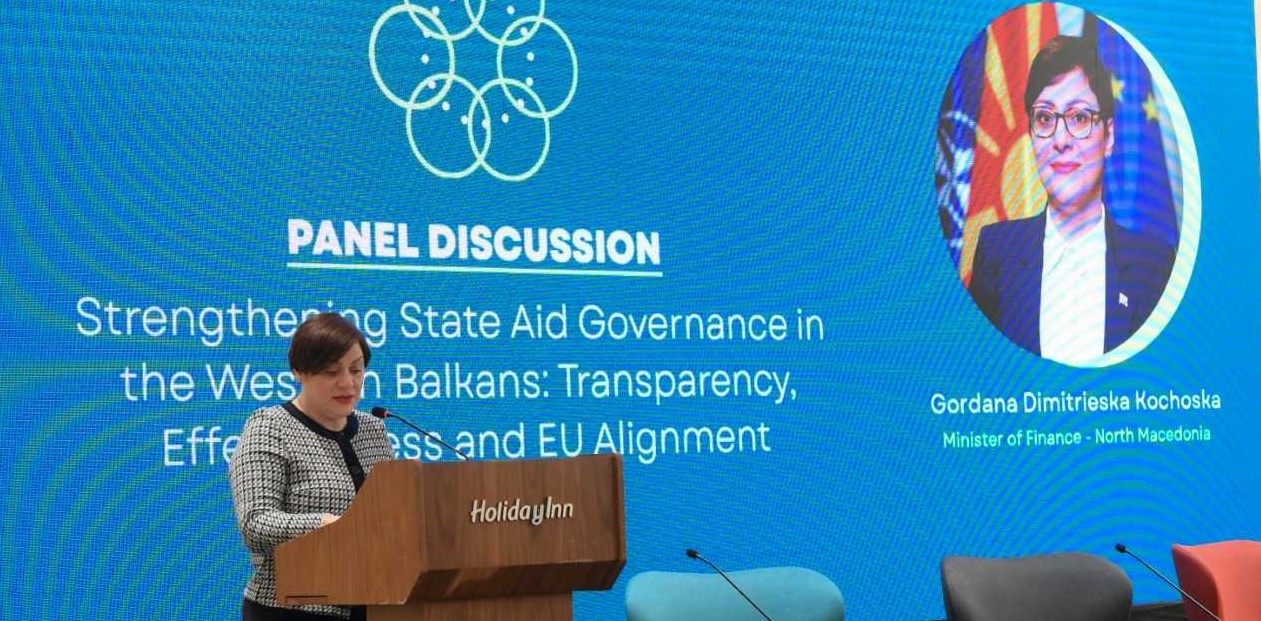
17th February 2026, Skopje - State aid must be clearly targeted, economically justified, and in support of boosted competitiveness and sustainable growth, Minister of Finance, Gordana Dimitrieska-Kochoska stated during the regional panel discussion entitled “Strengthening State Aid Governance in the Western Balkans: Transparency, Effectiveness, and EU Alignment,” organized by Finance Think.
In her address, the Minister underscored that any Denar in the Budget must be economically justified and serve a clear development objective, noting that fiscal policy is anchored in fiscal consolidation and accelerated economic growth - two closely interlinked goals.
“Fiscal discipline implies reducing non-productive costs and allocating funds where highest value added is generated. Thus, state aid is an instrument that must be meticulously designed, targeted, and assessed on continuous basis,” the Minister emphasized.
She also stressed that state aid must not become a burden on public finances, but rather an investment in competitiveness and sustainable growth. As per the data from the Commission for Protection of Competition, state aid amounted to EUR 206 million, or approximately 1.5% of GDP in 2023, reaching EUR 235.2 million, or 1.52% of GDP in 2024, thus highlighting the need for a high degree of accountability and transparency.
Minister underlined that economic indicators attest to the positive impact of investment support. The economy has recorded growth of around or above 3% for five quarters in a row, with growth reaching 3.8% in the third quarter of 2025, and gross investments rising by 30.6%, primarily driven by heightened activity in the private sector.
At the same time, the Government provided EUR 250 million as concessional funds to support companies’ investment projects, as well as additional EUR 250 million for municipal capital projects, aiming to boost economic activity and promote more balanced regional development.
By highlighting that significance of transparency, the Minister noted that the Government is introducing a centralized a system to record all expenditures allocated as state aid. She clarified that, at present, data on allocated state aid have been dispersed across multiple institutions, and that a unified, centralized system is required to provide for improved analysis, effective coordination among institutions, and efficient resource planning.
During the conference, attended by more than 40 representatives from institutions across the Western Balkan countries, discussions focused on the funding devoted to state aid by countries in the region, the common challenges they face, and the regional approaches to enhancing transparency and effectiveness as regards state aid governance.