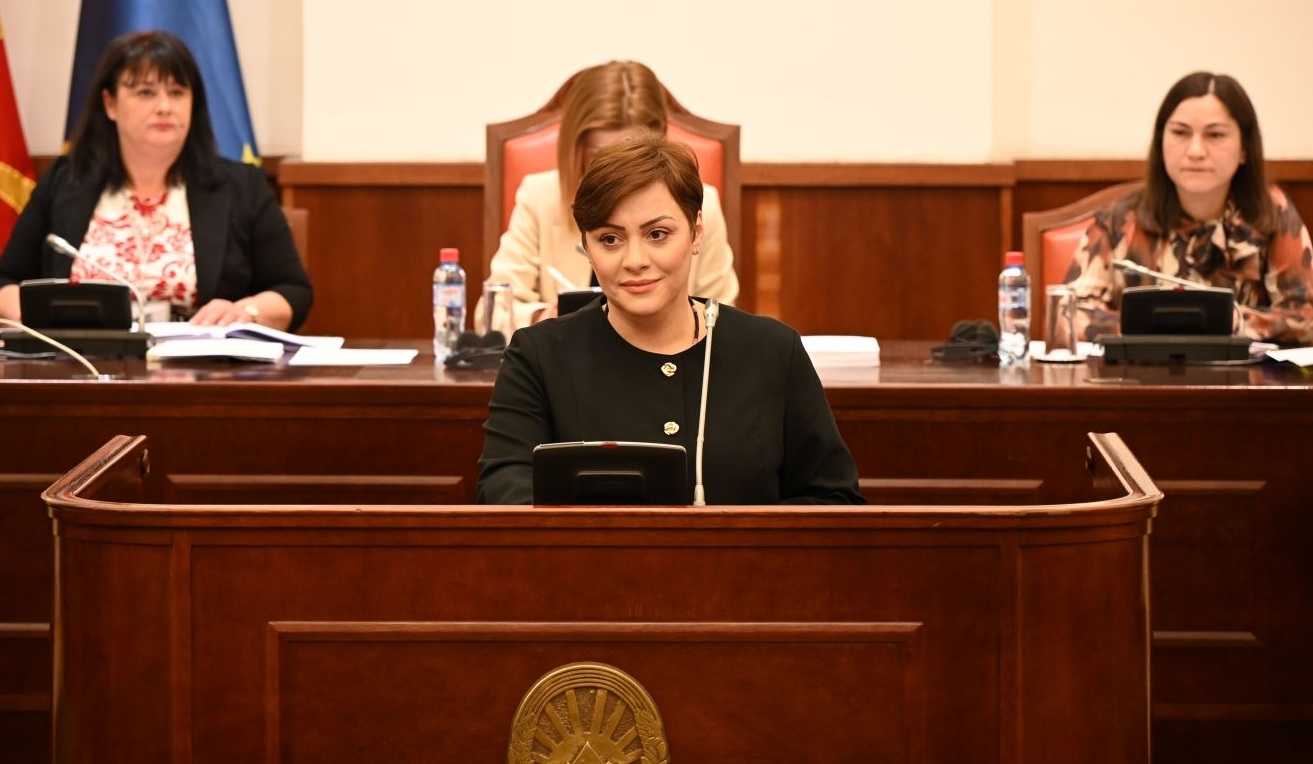
14th November 2025, Skopje - 2026 Draft Budget reaffirms Government’s commitment to stability, predictability and accountable public finance management. This Budget is more than a set of figures and tables, it sends a clear economic message - one of growth, investments and security for the citizens, the businesses and the institutions,
Minister of Finance, Gordana Dimitrieska-Kochoska, stated when elaborating on the 2026 Draft Budget before the Parliamentary Financing and Budget Commission.
She underscored that the Budget is built on a prudent and disciplined use of public funds, with a clear focus on sustainable economic development and higher living standards.
“2026 Budget proves that we can manage public finances wisely, with discipline and vision, even amid global challenges. It strengthens the trust in public institutions, underpins the role of the private sector as a driver of economic growth and creates favorable conditions for boosting both domestic and foreign investments”, said the Minister of Finance, noting that the 2026 Draft Budget maintains consistency in economic policies and is aligned with the 2026 - 2030 Fiscal Strategy.
“What matters the most for this Government is that we deliver results, not just making promises. We promised gradual fiscal consolidation to both the citizens and the international financial institutions and we remain committed to fulfilling this promise”, Dimitrieska-Kochoska emphasized.
Under the Draft Budget, the economy is expected to accelerate in 2026, with real GDP growth of 3.8%, driven primarily by the domestic demand. Gross investments will be the driving force of growth, supported by intensified implementation of infrastructure projects, along with increased investments in energy, rail, agriculture, education and healthcare. Private consumption is projected to grow by 2.6%, with public spending remaining moderate, rising by 1.4% in line with the fiscal discipline, while inflation is expected to stabilize to around 2.5%, amid stable prices on the international markets. These positive trends will also benefit the labor market - employment is projected to increase and average net wage to rise by 6.5%, supported by new production capacities and expansion of the existing ones, as well as the Government active employment measures and programs.
“Overall, 2026 projections point to continued economic stability and growth, supported by prudent fiscal policies, investments in infrastructure and human capital, as well as boosted productivity and competitiveness of the domestic economy”, the Minister emphasized.
As she underlined, the Draft Budget places special emphasis on improved collection of own revenues by the budget users, rational use of public funds, as well as realistic planning of capital expenditures. The system of subsidies and social transfers will be redesigned by introducing stricter criteria so as to ensure effective allocations, while fiscal discipline, transparency and digitalization of the processes will deliver more efficient and higher-quality public services.
“Total budget revenues in 2026 are projected in the amount of Denar 374.9 billion, with the revenue side carefully designed to maintain stable financial framework amid global uncertainty. Expenditures are projected in the amount of Denar 414.2 billion, aimed at ensuring stable functioning of the public services, infrastructure modernization, improved conditions in the healthcare, the education and the agriculture sectors, while sustaining public investments that yield long-term economic effect. Budget deficit is projected in the amount of Denar 39.2 billion in absolute terms, accounting for 3.5% of the projected GDP, being a decline of 0.5 p.p. in relation to 2025. This demonstrates the Government’s strong commitment to strict fiscal discipline”, the Minister said, pointing out that the upward expectation for GDP growth reflect on improved economic climate, increased investor confidence and boosted public investment activity.
Under the Draft Budget, wage-related expenditures are set at Denar 52.6 billion, being by around Denar 3 billion higher compared to 2025. Expenditures related to goods and services are projected at Denar 27.9 billion, reflecting a slight reduction of 0.5% in relation to the previous year. As per pension-related expenditures, Denar 116.8 billion is projected, including the increase set out in 2026 under the existing legislation. Additionally, Denar 12 billion is projected for social protection benefits for the most vulnerable categories. With respect to active employment measures and policies, including job creation programs, support for employment of young people, persons with disabilities and beneficiaries of guaranteed minimum income, Denar 2.6 billion is projected.
“Capital investments, amounting to Denar 40.2 billion, cover the major projects in transport, energy, education and healthcare infrastructure. The Government’s priority is to accelerate project implementation in order to modernize the country and improve the living conditions for both the citizens and the business community”, Dimitrieska-Kochoska said.
With respect to borrowing, the Minister emphasized that, in 2026, the Government plans timely and full repayment of liabilities totaling Denar 74.8 billion, with the Ministry continuing to pursue prudent public debt management, while ensuring adequate liquidity throughout the year. As for the deficit, it will be financed through domestic and foreign borrowing.
“2026 Draft Budget is yet another reaffirmation that delivering on commitments is essential to being recognized as a credible government and a reliable partner to the international community. Each denar of public funds has been carefully planned to deliver maximum value for the citizens and the economy, with strict adherence to the budget limits and gradual alignment with the 3% fiscal rule. Our objective is clear: by implementing the adopted fiscal consolidations policies and measures, we aim at reducing the budget deficit, keep the public debt under control and ensure long-term fiscal stability, which is the foundation for sustainable economic growth and a better standard of living for all citizens”, concluded the Minister of Finance, Gordana Dimitrieska-Kochoska, at the start of the debate at the Financing and Budget Commission.