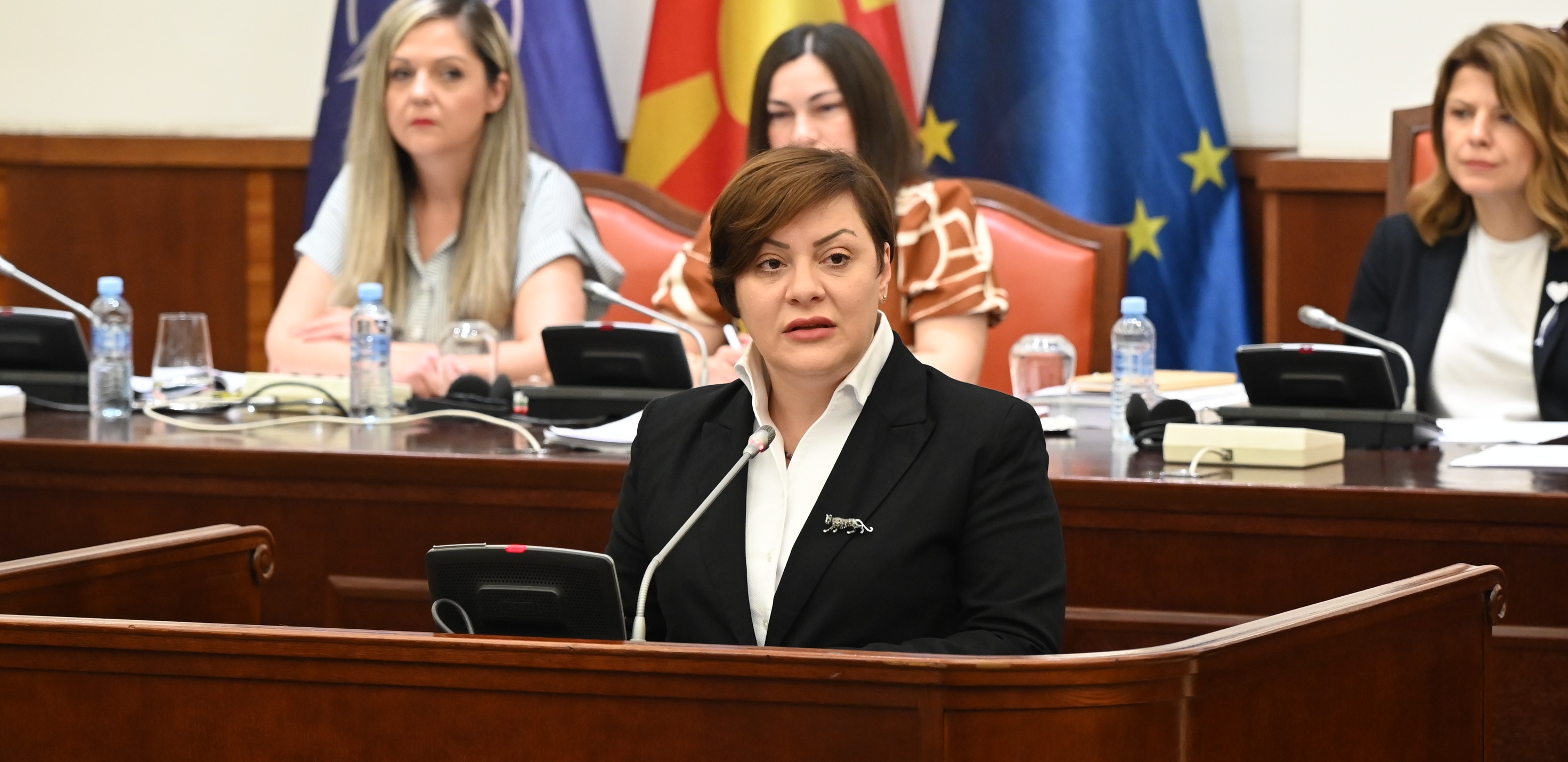
3rd July 2024, Skopje – Draft modifications and amendments to the 2026 Budget (2026 Supplementary Budget) are on the agenda of the parliamentary Financing and Budget Commission, as of today. The Minister of Finance, Gordana Dimitrieska-Kochoska, presented the Draft Supplementary Budget to the members of the Commission, emphasizing that the modifications and amendments reaffirm both the Ministry of Finance and the Government’s commitment to economic stability, development and responsible public finance management, while continuing along a path that is already yielding results - the positive momentum in the economy.
“What is the most important is that 2026 Supplementary Budget, which I present today before you and the public, is neither a result of shortage of revenues nor Budget liquidity issues. On the contrary. The Supplementary Budget is about aligning the fiscal projections with the prevailing economic trends, providing additional funds under the legal requirements ensuring wages are paid in full and on time in the sectors which have experienced wage increase, more funds for additional support to agriculture, social protection and the municipalities, and, most importantly, additional funding to speed up the infrastructure investment cycle”, the Minister said.
She also noted that the modifications and the amendments come at a time of global uncertainty, with the external geopolitical developments impacting the economic trends and affecting the 2026 Budget execution. Therefore, the Draft 2026 Supplementary Budget is aimed at adjusting the macroeconomic assumptions and the fiscal projections, primarily on the expenditure side.
“Supplementary Budget is not just about technical change in numbers, but it rather reflects Government’s policies aimed at supporting the economy and the citizens. It responds to changing economic circumstances and serves as a tool for aligning the public finances with the real needs of the economy, the institutions, the business sector and the citizens. In times of global uncertainty, our duty is to act promptly, identify the risks and, at the same time, to seize the opportunities that lie ahead,” the Minister pointed out, highlighting the measures undertaken to protect the living standard of the citizens and the liquidity of the companies.
The Minister emphasized that the Supplementary Budget upholds the commitment to timely payment of all obligations under the legal requirements, disciplined public finance management and prioritized financing of development policies.
Under the Supplementary Budget, total revenues are revised to Denar 379.5 million, with tax revenues remaining broadly consistent with the initial projections, standing at Denar 213.2 billion. Non-tax revenues demonstrate notable growth, up by nearly Denar 2 billion, with donations increasing by around Denar 2.7 billion.
On the expenditure side, total expenditures are revised to Denar 425.8 billion, with additional funds being allocated to clearly defined priorities:
agricultural subsidies (up by Denar 1.4 billion, totaling Denar 8.7 billion), subsidies for rail transport, sports support, and an additional Denar 500 million in support of student and pupil standard. Additional support is also provided for vulnerable groups through social transfers amounting to Denar 1.3 billion, companies hiring disabled persons, soup kitchens and deinstitutionalization measures, along with additional Denar 1.2 billion for healthcare, Denar 600 million of which as additional funding from the Central Budget for maternity leave payments.
She noted that the commitment to fiscal discipline is reflected in the Draft Supplementary Budget, as spending on goods and services is reduced by around Denar 837 million by reallocating the funds to priority needs. On the other hand, particular emphasis is placed on the development component, providing additional funds for capital investments of about Denar 46 billion, rising by around Denar 5.8 billion or by 14.5% relative to the initial Budget.
“The deficit increase is, for the first time, driven above all by higher capital expenditures and investments in infrastructure. This is a deficit that supports development, rising by 0.6 percentage points in relation to the initial projection, with the budget deficit being revised to Denar 46.1 billion, accounting for 4.1% of GDP. The funds are allocated to implementation of capital projects of strategic relevance for the country and the citizens, a principle that will remain central to the way this Government works”, Dimitrieska-Kochoska pointed out.
When elaborating on the Supplementary Budget, the Minister reflected on both the major macroeconomic performance in 2026 and the Budget execution, emphasizing that capital spending rose by 53.5% compared to last year, while domestic and foreign debt repayment totaled Denar 72.7 billion.
The Minister noted that the Budget is the key strategic document that integrates all Government policies, sustaining the medium-term path of pursuing the fiscal policy and the concept and vision for higher growth rates. It is a platform for prosperity, ensuring stability in the economy and for the citizens. A platform of economic stability, development and responsible public finance management, securing sound public finances, while creating conditions for scaled-up investments, stronger economic activity and better standard of living for the citizens.
The debate in the Financing and Budget Commission about the Draft 2026 Supplementary Budget lasts a maximum of 10 days. Altogether, 226 amendments have been submitted.