
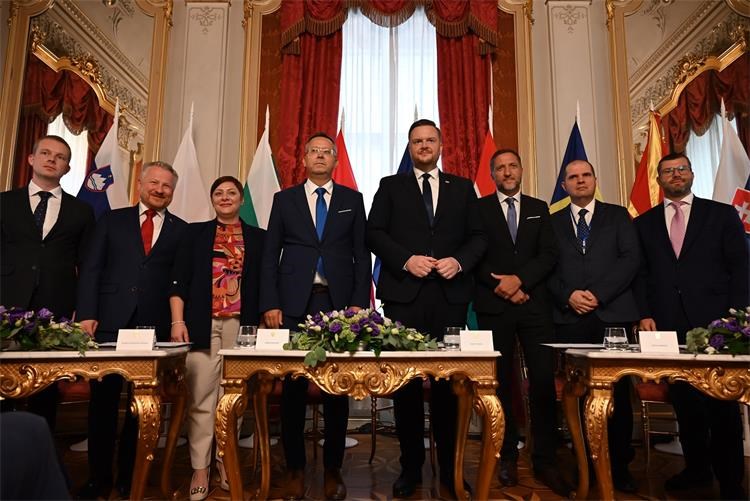
25th August 2025, Zagreb – Today, in Zagreb, Minister of Finance, Gordana Dimitrieska-Kochoska, together with Ministers of Finance and Economy of Bulgaria, Croatia, Hungary, Poland, Romania, Slovakia and Slovenia signed a Memorandum of Understanding in respect of cooperation for capital markets development.
This initiative aims to foster joint development of the national capital markets among the participating countries through closer cooperation and regulatory alignment, while boosting market liquidity and establishing stronger, more visible, efficient, and competitive capital markets as the ultimate goal thereof.
By leveraging the full potential of capital markets and the broader financial sector, the MoU participants aim to strengthen their economies and deepen the mutual cooperation.
The signing of this Memorandum builds upon the Memorandum of Understanding signed in late 2024 by the stock markets in Bratislava, Bucharest, Budapest, Ljubljana, Skopje, Sofia, Warsaw and Zagreb, all to the end of deepening the cooperation and the integration of capital markets across Central and South-East Europe, with the European Bank for Reconstruction and Development (EBRD) as a steadfast support of this process, i.e. initiative.
The countries participating in the ceremonial signing of the MoU confirmed their shared political will and vision to strengthen the capital markets across Central and South-East Europe, while also increasing their efficiency and competitiveness.
Thus, their commitment to the cooperation is reaffirmed, emphasizing the importance of capital market development and taking steps necessary for strengthening Central and South-East Europe markets capacities in order to finance growth, attract investments and promote sustainable economic development.
The Memorandum is also aligned with the European Union objectives, particularly its Savings and Investment Union Strategy, which aims to channel household savings and private capital towards capital markets to boost investments, especially in small- and medium-sized enterprises, streamline cross-border capital flows and build a more integrated, liquid and resilient capital market within the European Union.