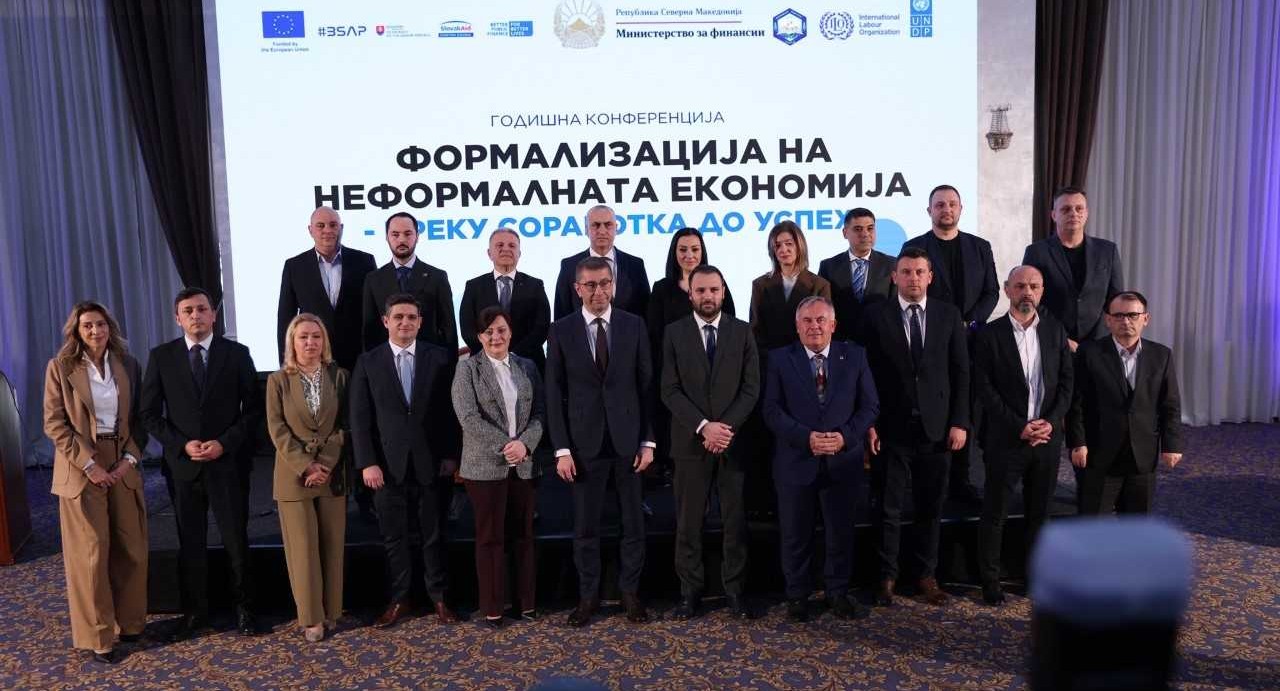
18th February 2026, Skopje – At today’s Annual Conference, covering the topic “Formalization of the Informal Economy: Through Cooperation to Success”, representatives of Government, business community, trade unions and academia conveyed a message underscoring the importance of joint action in reducing the informal economy. Conference was organized by the Government of Republic of North Macedonia/Ministry of Finance United, along with the United Nation Development Program - UNDP, the International Labor Organization (ILO), and the Faculty of Economics – Skopje. The official opening of the Conference was marked by addresses delivered by
Hristijan Mickoski, President of the Government of the Republic of North Macedonia, Gordana Dimitrieska-Kochoska, Minister of Finance of the Republic of North Macedonia, Besar Durmishi, Minister of Economy and Labor of the Republic of North Macedonia, Mijalche Santa, Dean of the Faculty of Economics with the Ss. Cyril and Methodius University in Skopje Emil Krstanovski, International Labor Organization Coordinator for North Macedonia, Armen Grigoryan, UNDP Resident Representative for the Republic of North Macedonia.
“Our objective is clear - to ensure that the formal economy becomes more attractive than the informal economy. Operating legally should be easier, more profitable, and more secure. However, it is important to acknowledge that these efforts cannot be limited to inspections alone, it requires a systemic approach as well. Therefore, the Government is implementing a range of measures, including the digitalization of processes - such as e-invoicing, electronic reporting, interconnection of databases, reduction of administrative barriers to business registration, incentives for formal employment, support for micro and small-sized enterprises, as well as enhanced transparency and data exchange among institutions,” the Prime Minister underlined in his opening address, adding that the Government’s strategy is founded on three key principles: streamlining, fairness, and support.
Minister of Finance, Dimitrieska-Kochoska stated that, through a systemic and determined approach focused on addressing unfair competition and creating fair and transparent working conditions, the Government will act to formalize the informal economy.
“Our goal is formalization, fairness and creating level playing field for all. We will pursue a systemic and resolute approach by tackling unfair competition, fostering fair and transparent business conditions, and ensuring that law-abiding companies are not placed at a disadvantage. Formalization will be fostered through streamlined administrative procedures, simplified registration process and clear rules. We will encourage entities operating in the informal sector to transition into the formal economy through support, not solely through sanctions,” the Minister emphasised.
Minister of Economy and Labor, Besar Durmishi, noted that reducing the informal economy requires systemic, consistent, and sustainable solutions.
“Engagement in informal economy operations often comes with unsafe conditions, long working hours, unregulated employment relationships, and limited social and legal protection. Undeclared workers are deprived of the basic rights arising from employment, while companies operating legally are placed at a disadvantage. Therefore, informal economy reduction requires systemic, consistent, and sustainable solutions. Allowing the grey economy to persist undermines economic growth, limits public services, and diminishes quality of life. Ministry of Economy and Labor has already been implementing active policies through the Employment Operational Plan. However, the analyses have demonstrated that some individuals continue to remain outside formal channels. For this reason, EUR 40 million has been allocated in the current year for the new Employment Operational Plan, with measures designed to directly contribute to formalization and job creation. Additionally, the Law on Work Engagement of Individuals has been adopted, with its primary objective being the formalization of particular forms of employment and addressing the real needs of the labor market. “Starting 1st January 2026, the Law on Financial Support of Investments will also come into effect, providing incentives for companies that invest, create jobs, and attain growth,” Durmishi noted.
Mijalche Santa, Dean of the Faculty of Economics with Ss. Cyril and Methodius University in Skopje, stated that the fight against informal economy is a long-term endeavor, thereby stressing that this requires stable institutions, a predictable regulatory environment, incentives for formalization, and a continuous dialogue among the Government, the businesses, the employees, and the expert community. Faculty of Economics - Skopje will continue to be a reliable partner in this process through research, analysis, education, and public debates. Our mission is to contribute to creating policies based on knowledge and evidence, in support of sustainable economic and national development. In order to reduce the informal economy, we must build a stronger, fairer, and more competitive formal economy - one where rules are transparent, institutions operate efficiently, and trust is a common value, the Dean of the Faculty of Economics pointed out.
According to Emil Krstanovski, National Coordinator of the International Labor Organization, formalizing the informal economy is crucial for promoting decent work, social justice, and inclusive economic growth, as viewed from ILO’s perspective.
“Informality often entails the absence of workers’ rights, social protection, and safe and healthy working conditions, while simultaneously undermining productivity, public revenues, and fair competition. By promoting a balanced approach that combines supportive measures for businesses, stronger labor protection, social dialogue, and effective yet fair enforcement, formalization helps workers enjoy security and rights, as well as businesses to compete on an equal footing, while also allowing the Government to expand social protection and sustainable development,” Krstanovski stated.
According to Armen Grigoryan, UNDP Resident Representative for the Republic of North Macedonia, the Support to Public Finance Management Reform Project, financed by the Ministry of Finance of the Slovak Republic, has provided for putting a sophisticated system in place, which provides a clear and accurate picture of the informal economy’s actual scale.
“By equipping auditors with new analytical tools, we have made certain that each fiscal recommendation is underpinned by accurate and reliable data. Beyond this, efforts also supported the alignment of national strategies and the introduction of digital tools for real-time monitoring, thus ensuring that upcoming decisions and solutions are firmly grounded in evidence,” the Resident Representative of the United Nations Development Programme (UNDP) stated.
As part of the Conference, “Declaration on Partnership and Action: Joint Commitment to the Formalization of the Informal Economy in North Macedonia” was signed. was signed. Its signatories included representatives of key ministries, chambers of commerce, organizations of employers, trade unions and academia.
“At the Conference panel discussions, participants engaged in debates on creating policies for efficient formalization of the informal economy, entitled: “How to create a labor market, business and institutional environment that encourage citizens, workers, and businesses to operate in the formal sector.” Professors Borche Trenovski and Biljana Tashevska from the Faculty of Economics within Ss. Cyril and Methodius University, delivered a presentation on the topic of “Determinants and Effects of the Informal Economy – with Special Reference to the Republic of North Macedonia”.