
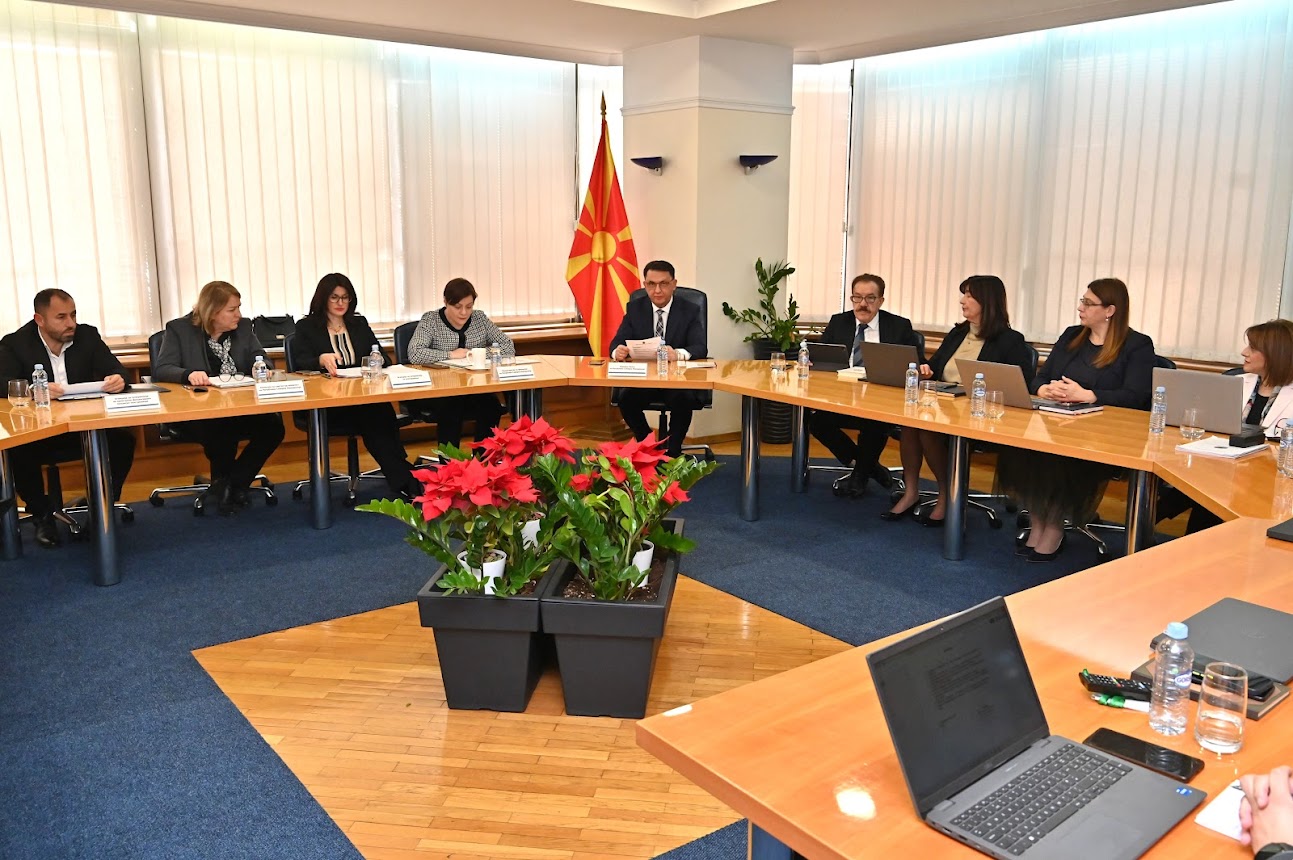
22nd December 2025, Skopje - Financial stability has been preserved, while the financial system continues to demonstrate solid resilience and capacity to cope with the ongoing challenges. These assessments were presented at the meeting of the Financial Stability Committee, held in the National Bank, which was attended by Trajko Slaveski, Governor of the National Bank, Gordana Dimitrieska-Kochoska, Minister of Finance, Bujare Abazi, President of the Securities and Exchange Commission, Remzi Bajrami, President of the Agency for Supervision of Fully Funded Pension Insurance (MAPAS) and Eli Drakulovska, President of the Council of Experts of the Insurance Supervision Agency.
Macroeconomic climate is more favorable, but remains uncertain. Trade uncertainty, geopolitical tensions, disrupted supply chains and policy unpredictability pose heightened risks to the global economy, and in turn, the domestic economy. As a small and open economy, the country is susceptible to external shocks. However, the effects of these risks are currently assessed as limited, and the financial system resilience to shocks has significantly strengthened.
In the third quarter of 2025, the banking sector-maintained stability and ensured uninterrupted financial intermediation. Banks operated in a more stable environment, however, uncertainty associated with trade barriers and global policies still persisted. During this period, greater credit and deposit activity was observed, accompanied by a further reduction of the euroization of the banks’ balance sheets.
“The banking sector maintains solid solvency, reaching its highest levels since 2006, coupled with sufficient liquidity levels. Quality of the credit portfolio remains solid, with non-performing loans reducing to a historic low of 2.3%, whereby no deterioration is expected from the portfolio of restructured loans and loans with extended maturity, which are small in volume and keep decreasing. Banks’ profitability remains strong and continues to serve as a significant source for further capital growth, although it is slightly lower compared to the previous period. National Bank’s macroprudential measures continue to play a key role in strengthening the solvency and the resilience of the banking sector to potential shocks”, Governor, Trajko Slaveski, PhD, pointed out.
“Maintaining the overall financial system stability is crucial for effective implementation of the economic policies pursued by the Government and the Ministry of Finance. Therefore, measures and activities have been taken to improve the legislation, as well as financial companies and leasing companies, for the purpose of providing easier access to financing and protecting consumers”, Minister of Finance, Gordana Dimitrieska-Kochoska said.
“Securities and Exchange Commission has been continuously strengthening its regulatory and supervisory approach to the capital market, where total market capitalization of stocks and bonds amounted to Denar 378.5 billion as of 30th November 2025, while MBI-10 index registered an annual growth of nearly 12%. At the same time, net value of the assets of the investment funds reached Denar 28.5 billion as of 30th November 2025, recording an increase by 47% compared to last year. Against a backdrop of greater digital dependence among financial institutions, the Securities and Exchange Commission will further be committed to improving the cyber resilience of the vital market infrastructure, as a prerequisite for long-term integrity and development of both the capital market and the financial system as a whole,” President of the Securities and Exchange Commission, Bujare Abazi, MA, underscored.
President of the Council of Experts of the Agency for Supervision of Fully Funded Pension Insurance - MAPAS, Remzi Bajrami, stressed that in conditions of heightened uncertainty on the global financial markets and gradual stabilization of the monetary policies, the fully funded pension insurance continues to play important role in preserving financial stability through long-term and prudent investments, predominant investments in domestic government securities, and appropriate geographic and sectoral diversification. At the same time, the competent institutions prudently monitor the risks associated with interest rate trends, inflation and liquidity through coordinated supervision and exchange of information, for the sake of timely mitigation of any potential systemic risks. Hence, activities are undertaken to introduce the multi-fund concept, as a structural reform that will provide for more aligned management of investment risks according to the member’s life cycle, increase in the long-term returns and further strengthening of the resilience and stability of the pension system.
In her address, Drakulovska, President of the Council of Experts of the Insurance Supervision Agency, concluded that the insurance market in non-life and life segments in 2025 will result in continued growth. During the first nine months this year, investments in insurance reached Denar 13.80 billion (EUR 223.77 million), surging by 13.3% compared to the same period in 2024. During the same period, insurance companies paid a gross amount totaling Denar 4.82 billion as claims, growing by 11.4% compared to the same period last year. As regards legislation and alignment with the EU standards, Drakulovska said that the Insurance Supervision Agency and the Ministry of Finance will complete the activities related to preparation of the new Insurance Law. Moreover, Insurance Supervision Agency initiated preparations for implementation of the International Financial Reporting Standard IFRS 17. In the field of supervision, the Insurance Supervision Agency will place greater emphasis on strengthening the supervisory capacities and the gradual introduction of risk-based supervision.
The Committee highlighted the need for further close monitoring and prudent risk management by financial institutions, as well as when pursuing economic and financial policies, in support of the maintenance of financial stability in the following period as well.