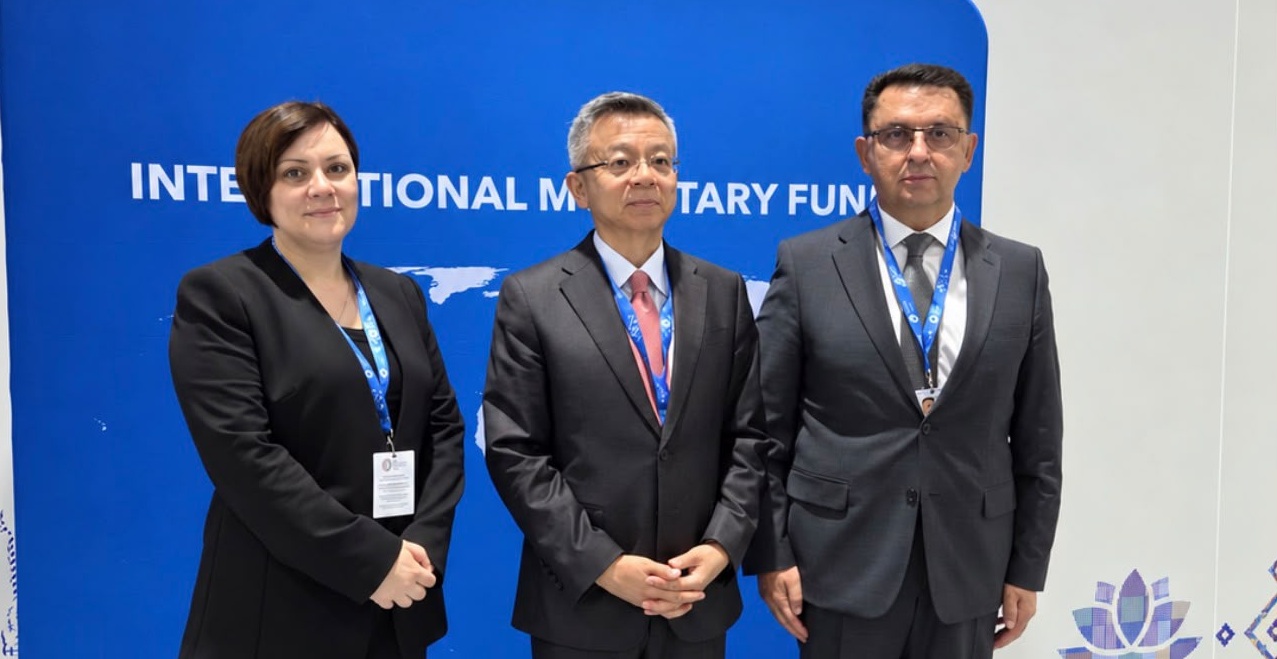
15th October 2026, Bangkok - Ministry of Finance continues to implement reforms aimed at strengthening public finance management and maintaining prudent fiscal policy that envisages a gradual reduction of the budget deficit, without compromising economic growth. These efforts are helping move the country forward and create conditions for a higher standard of living for the citizens, Minister of Finance, Gordana Dimitrieska-Kochoska, said at the meetings with senior IMF representatives during the IMF and World Bank Annual Meetings, taking place this year in Bangkok, Thailand.
At the meetings with IMF Deputy Managing Director, Bo Li, Director of the IMF’s European Department, Mateusz Szczurek, IMF Executive Director, Jeroen Clicq, and Alternate Executive Director, Marnix van Rij, the Minister emphasized that the Government and Ministry of Finance’s foremost priority is to achieve medium-term fiscal consolidation objectives set out in the Fiscal Strategy, while simultaneously fostering stronger economic growth.
“Ministry of Finance is in the process of drafting the 2027 Budget, while the 2026 Supplementary Budget is currently undergoing parliamentary procedure. We are carefully managing public finances, given the heightened uncertainty we continue to face and the need to implement measures aimed at protecting the citizens’ standard of living, while also supporting the businesses. To this end, Supplementary Budget introduces adjustments on both the revenue and the expenditure side in order to preserve fiscal discipline and avoid additional pressure on the budget deficit”, the Minister said.
She underlined that the budget deficit remains within the projections and continues to support the implementation of Government’s development policies, particularly major investment projects.
According to the Minister, this approach is crucial for supporting the economic growth and preserving the positive growth trend over the past two and a half years, with growth rates consistently exceeding 3%.
As emphasized at the meetings, GDP grew by 4.3% year-on-year in Q2 2026, the strongest performance recorded in the post-COVID period. This reflects the continued positive trajectory of the economy and its resilience despite the uncertainties in the global economic environment. Following the growth of 3.1% in the first quarter, economic growth reached 3.7% in the first half of the year. A particularly important contributor to this performance has been the robust growth in gross investments, supported through the Budget. Moreover, in line with the 2027 - 2031 Fiscal Strategy, gross investments will continue to be one of the key drivers of economic growth.
2027 - 2031 fiscal policy is focused on creating preconditions for a new cycle of economic growth through increased capital investments, gradual fiscal consolidation and strengthened public finance management. At the same time, fiscal consolidation provides the foundation for preserving stability and ensuring sustainable and inclusive economic growth. In the light of this context, the Minister highlighted that the budget deficit, as per the medium-term projections, will decline to 2.8% in 2029.
Discussions with the IMF also covered the developments in the country’s pension system, with IMF representatives expressing particular interest in the set-up of the second pension pillar. The matter is expected to be one of the key topics during the upcoming IMF mission to Macedonia scheduled for November. The pension system is also being covered within the World Bank’s Spending Review, with the objective of obtaining a more in-depth assessment and supporting measures to strengthen its sustainability.
IMF representatives welcomed the Government’s commitment to advance fiscal consolidation and encouraged the authorities to continue implementing the reforms that will strengthen public finance management and increase the resilience of public finances.